English speaking exam practice: Cambridge and IELTS
The speaking test is often the part of an English exam that people fear most, and the one they practise least, because you need someone to talk to. This page explains the speaking tests of four popular English exams, helps you choose your level and shows how to practise out loud, even on your own. Goudilingua lets you take full mock speaking tests with an AI examiner.
7-day free trial, no card needed: your email address is all it takes. Ages 18 and up.
The four exams at a glance
The Cambridge exams are taken in pairs: two candidates, two examiners. One examiner (the interlocutor) asks the questions; the other (the assessor) listens and marks. IELTS is taken alone, with one examiner, and the test is recorded.
Exam: B1 Preliminary (PET)
- Target level
- B1
- Speaking test length
- 12 to 17 min
- Format
- 4 parts, in pairs
Exam: B2 First (FCE)
- Target level
- B2
- Speaking test length
- 14 min
- Format
- 4 parts, in pairs
Exam: C1 Advanced (CAE)
- Target level
- C1
- Speaking test length
- 15 min
- Format
- 4 parts, in pairs
Exam: IELTS Speaking
- Target level
- all levels (bands 0 to 9)
- Speaking test length
- 11 to 14 min
- Format
- 3 parts, alone
In Cambridge exams, the speaking paper gets its own score on the Cambridge English Scale, and your overall result is the average of all the papers. In IELTS, speaking gets a band from 0 to 9, in half bands.
How to choose your level
Cambridge exams follow the Common European Framework of Reference (CEFR), from A1 (beginner) to C2 (proficient). Some simple speaking benchmarks:
- B1: you can describe your day, give a simple opinion and cope when travelling. Exam: B1 Preliminary.
- B2: you can discuss social topics, compare and argue without searching too much for words. Exam: B2 First.
- C1: you can speak fluently about abstract topics, add nuance and rephrase. Exam: C1 Advanced.
Each Cambridge exam also reports a level either side: an excellent score earns you the level above, and a slightly lower score can still earn a certificate at the level below. IELTS has no fixed level: everyone takes the same test and your band shows your level. It is often required for study or immigration in English-speaking countries.
If you are unsure, start with a mock test at the level you think you have. If it feels very easy, move up; if you keep getting stuck, move down.
Why practising out loud matters
Many learners understand written English well but freeze when they have to speak. That is rarely a lack of knowledge; it is a lack of practice. Speaking means finding words in real time, carrying on after a mistake and keeping an eye on the clock.
- Fluency comes from speaking, not from reading. Reading a list of useful phrases is not enough: you need to say them, several times, in a real exchange.
- Knowing the format lowers stress. When you already know what each part looks like, you can focus on what you say.
- Time goes fast. One minute to talk about photos feels short if you have never tried, and very long if you run out of ideas.
- Pronunciation improves with use: sounds, word stress and intonation become natural only when you produce them regularly.
What examiners assess
The exact criteria differ between exams, but the same ideas come up every time:
- Grammar and vocabulary: are they varied and accurate enough for the level?
- Organisation (Discourse Management, or Fluency and Coherence in IELTS): do your ideas connect, and do you develop your answers?
- Pronunciation: are you easy to understand? Having an accent is not a problem in itself.
- Interaction (Cambridge): do you listen to your partner, respond to their ideas and invite them to speak?
The goal is not to make zero mistakes, but to communicate clearly and show the range of what you can do.
Common mistakes on the day
- Giving one-word answers. Add a reason or an example: “Yes, I do, because…”
- Learning answers by heart. Examiners notice, and memorised speeches rarely fit the question.
- Ignoring your partner in Cambridge paired tasks. Ask “What do you think?” and react to what they say.
- Stopping after a mistake. Correct yourself quickly if you can, then keep going.
- Speaking too fast because of stress. A calm pace is clearer and gives you time to think.
Practising with Goudilingua
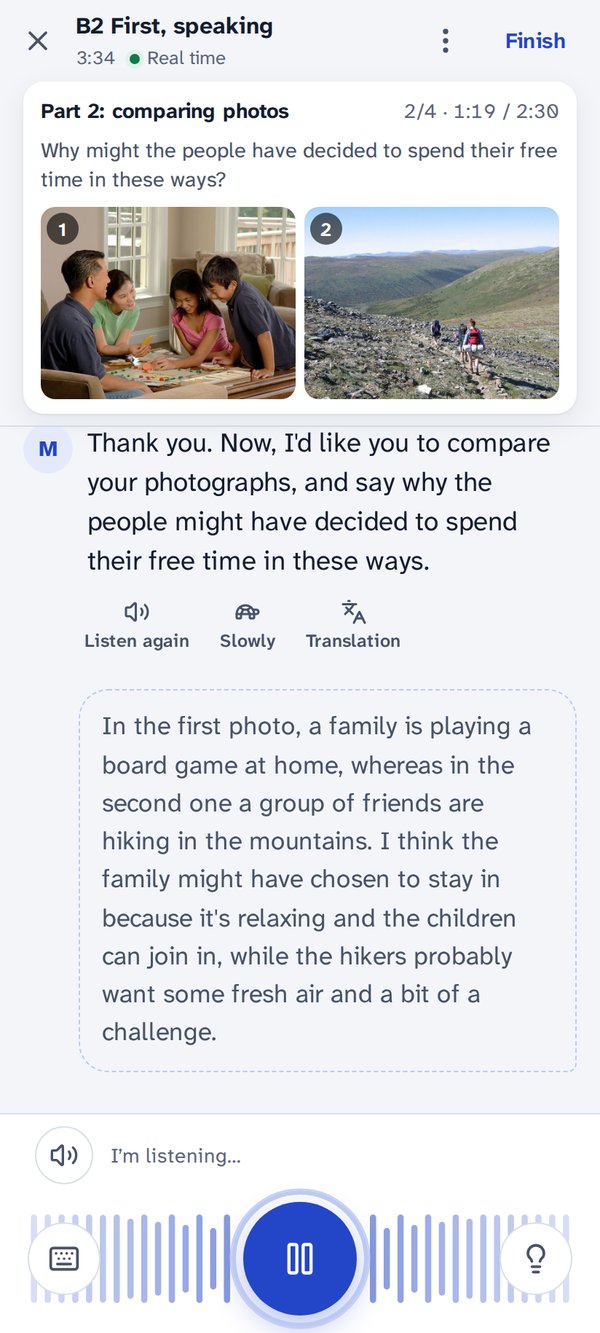
With Goudilingua, you speak English out loud with an AI, and it answers out loud. Its exam mode simulates the B1 Preliminary, B2 First, C1 Advanced and IELTS speaking tests:
- a variety of original tests for each exam, in the official format;
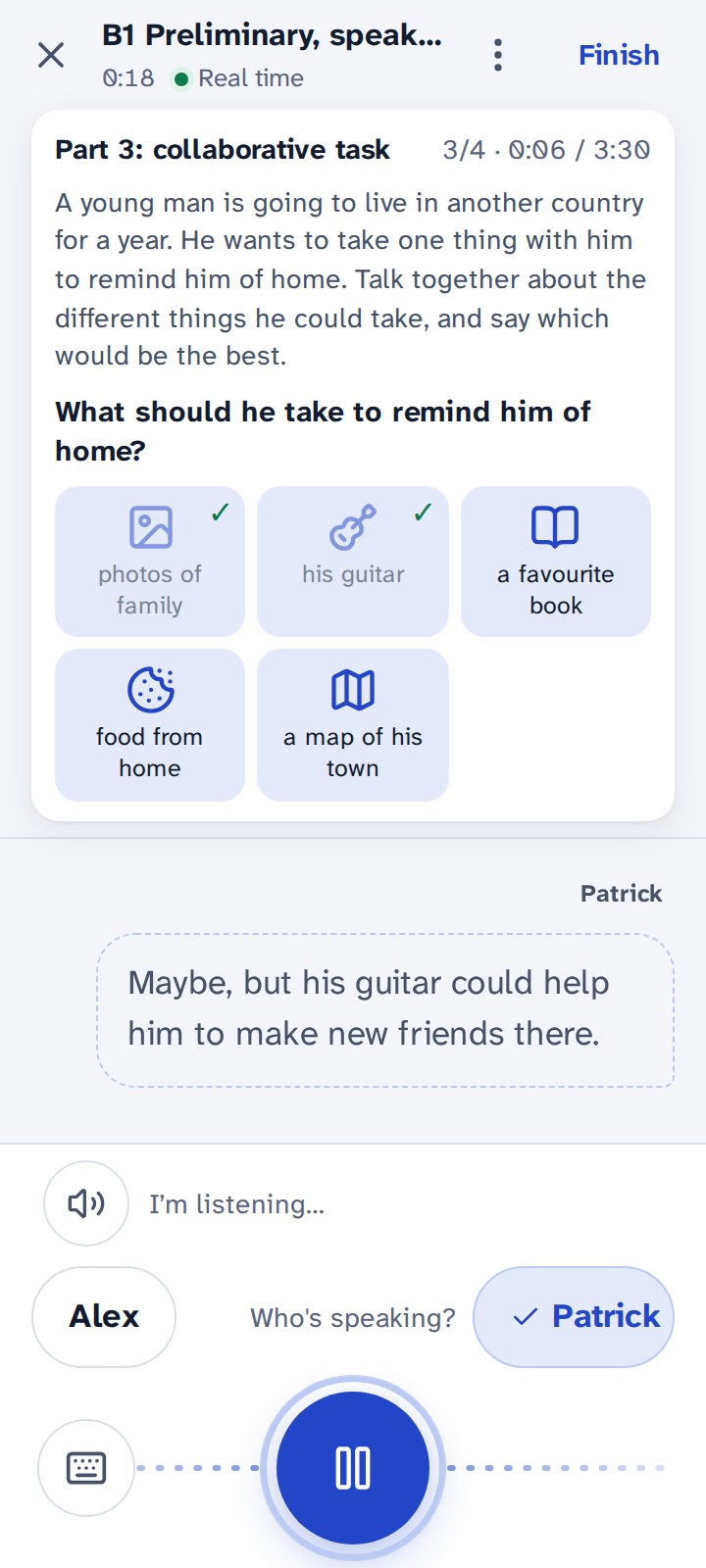
- an examiner and a partner, each with their own voice, for the paired tasks; or, if you practise with a friend, you take the test together on the same phone, each with your own questions and report;
- a visible timer for each part, and exam-style photos and task cards;
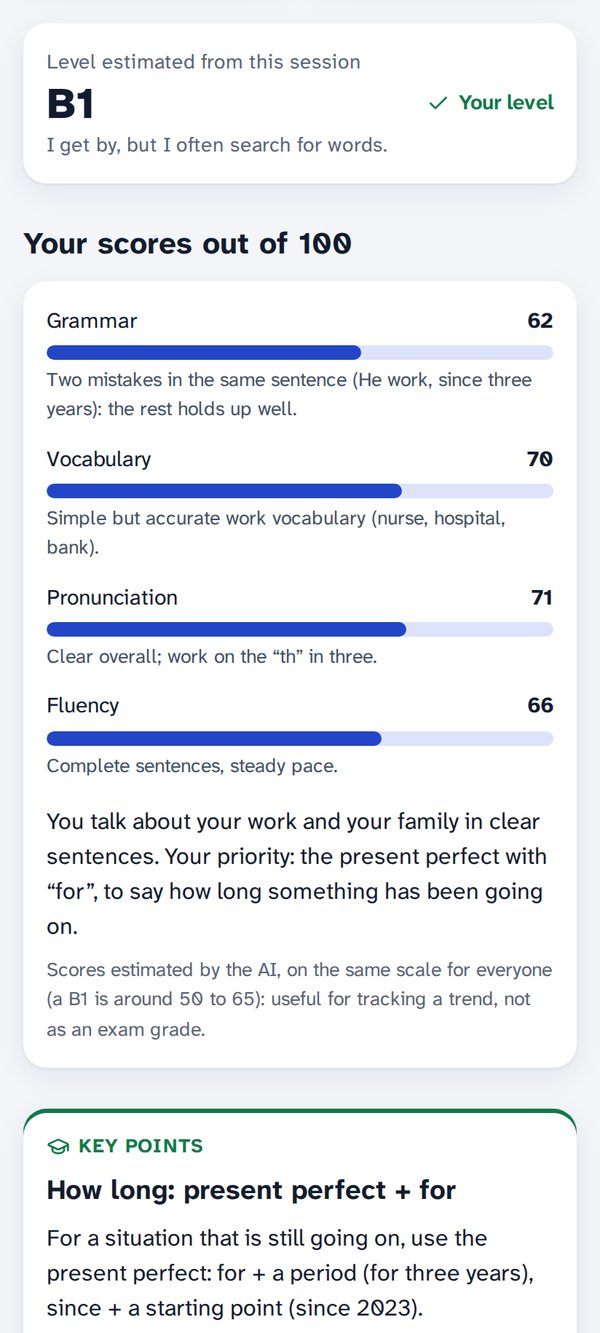
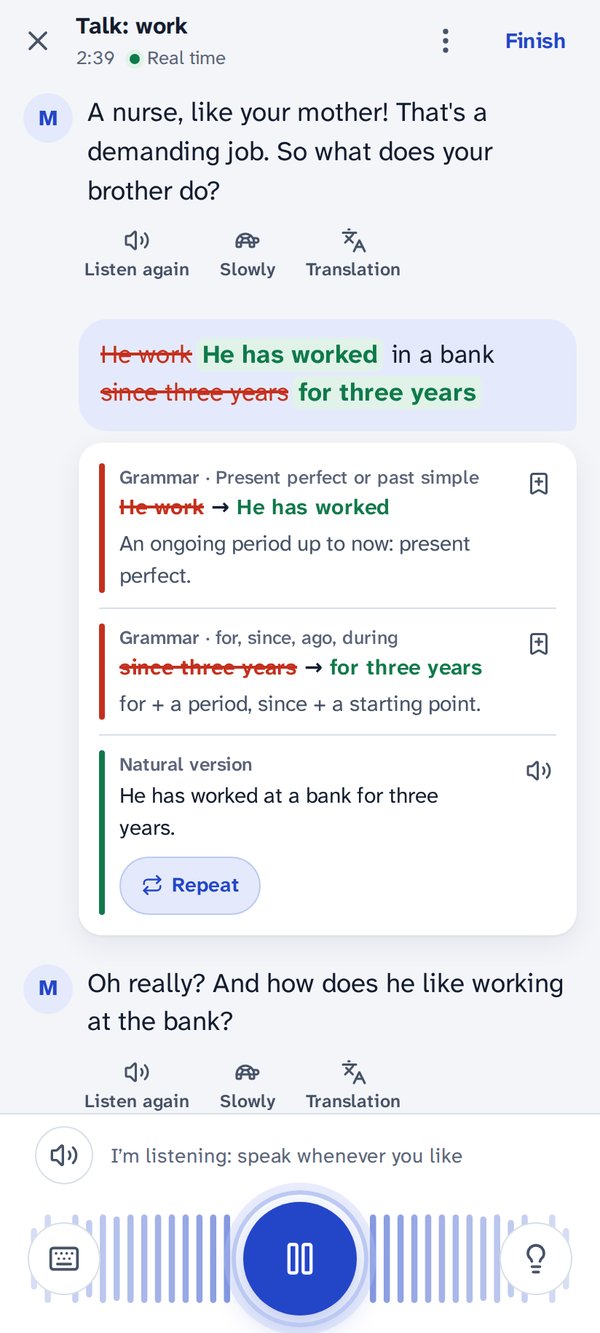
- no corrections during the test, just like the real exam; everything is in the final report: an estimated score, a mark for each official criterion, feedback on each part and 3 tips.
The app runs in your phone's browser (Android, Chrome) and can be installed like an app. You create your account with your email address, and that's it: nothing else to set up. Goudilingua offers a 7-day free trial, no credit card needed, then a subscription with no commitment.
The score is an AI estimate based on the published descriptors, not an official result. Goudilingua is not affiliated with Cambridge University Press & Assessment or with IELTS (British Council, IDP, Cambridge).
Frequently asked questions
Which English exam should I take?
If you want a certificate that proves a specific level and does not expire, Cambridge exams are a good choice. For university study or a visa in an English-speaking country, IELTS is often required: check what the organisation asking for it accepts.
Can I really practise speaking on my own?
Yes, as long as you speak out loud and under time limits. In Goudilingua, an examiner asks the questions and, in paired tasks, a virtual partner (a different voice) discusses with you, unless you practise with a friend on the same phone.
Is the Goudilingua score official?
No. It is an AI estimate based on the published criteria, useful for tracking your progress. Only the real exam gives an official result.
Is Goudilingua free?
You can try it free for 7 days, no credit card needed: your email address is all it takes. After that, it's a subscription with no commitment.
Is Goudilingua linked to Cambridge or IELTS?
No. Goudilingua is not affiliated with Cambridge University Press & Assessment or with IELTS (British Council, IDP, Cambridge). All test material is original.

Speak English, fear-free. A little better every day.
7-day free trial, no card needed: your email address is all it takes. Ages 18 and up.