IELTS Speaking test: format, examples and practice
The IELTS Speaking test lasts 11 to 14 minutes and is taken alone, with one examiner. It is the same for IELTS Academic and IELTS General Training, and it is recorded. Here is how the three parts work, how your band is decided and how to practise effectively.
7-day free trial, no card needed: your email address is all it takes. Ages 18 and up.
IELTS Speaking test format
Part 1
Time: 4 to 5 min
What you do: Introduction, then questions on familiar topics (home, work, studies, free time…)
Part 2
Time: 3 to 4 min
What you do: A task card: 1 min to prepare with notes, speak for 1 to 2 min, then 1 or 2 rounding-off questions
Part 3
Time: 4 to 5 min
What you do: A more abstract discussion linked to the Part 2 topic
Part 1. Simple, direct questions: “Do you work or are you a student?”, “What do you like about your neighbourhood?”. Answer in two or three sentences, with a reason or an example.
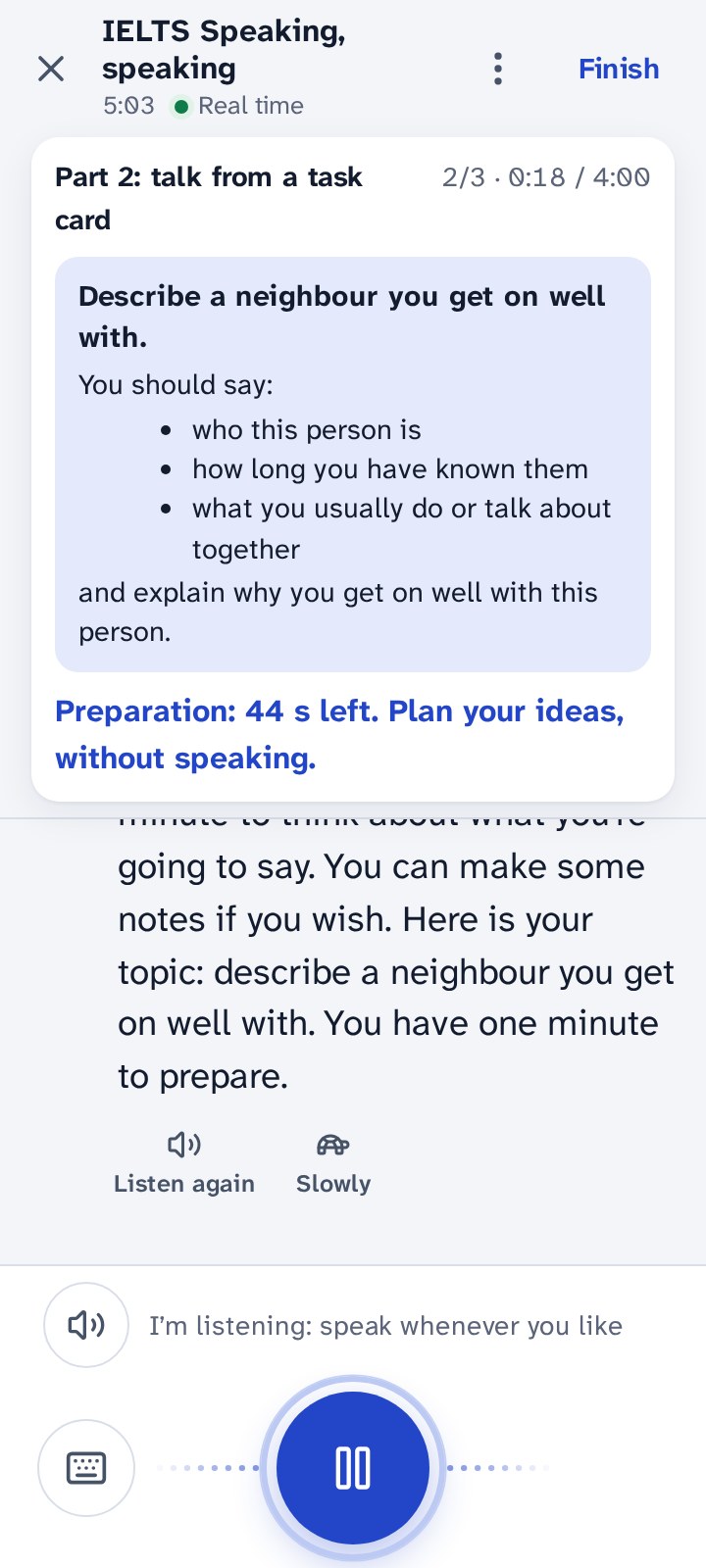
Part 2. The examiner gives you a card that starts with “Describe…”, followed by “You should say:” and three or four points, then “and explain…”. You have one minute to write down key words, then you speak alone for up to two minutes. The examiner stops you when the time is up.
Part 3. More general, abstract questions on the same theme: causes, effects, past versus present, advantages and disadvantages.
Assessment criteria and bands
Four criteria, each with equal weight:
- Fluency and Coherence: speaking without long pauses, with well-connected ideas.
- Lexical Resource: varied, precise vocabulary and the ability to paraphrase.
- Grammatical Range and Accuracy: a variety of structures with few errors.
- Pronunciation: being easy to understand, with good word stress and natural intonation.
You receive a band from 0 to 9, in half bands (6, 6.5, 7…). Many universities often ask for 6.5 or 7, but this is not a fixed rule: check the level required by the institution or organisation concerned.
Example questions
- Let's talk about your hometown. What do you like most about it?
- How often do you use public transport? Why?
- Describe a time when you helped someone. You should say: who you helped, what the situation was, how you helped them, and explain how you felt afterwards.
- Do you think people are less willing to help strangers than in the past?
- What role should governments play in encouraging volunteering?
Sample cue card and useful phrases
Sample task card (Part 2):
- Describe a skill you learned that you are proud of.
- You should say: what the skill is, when and how you learned it, who helped you,
- and explain why you are proud of it.
Useful phrases:
- Starting: I'd like to talk about…, The first thing that comes to mind is…
- Structuring: As for how I learned it…, What made it special was…
- Buying time: That's an interesting question; I haven't really thought about it before, but…
- Part 3: On the one hand… on the other hand…, Compared to our grandparents' time…, It's probably because…
Common mistakes
- Writing full sentences during the preparation minute. Note key words for each point instead.
- Stopping after 40 seconds in Part 2. Aim for the full two minutes: add an example or a short story.
- Answering Part 3 as briefly as Part 1. Develop each answer: idea, reason, example.
- Memorised answers. Examiners are trained to spot them, and they often miss the question.
- Using rare words just to impress. Natural, precise vocabulary scores better than misused “big” words.
- Monotone delivery. Intonation and word stress are part of Pronunciation.
Tips for the day
- Treat Part 1 as a warm-up: relaxed, natural answers.
- In Part 2, cover every point on the card; it gives your talk a clear structure.
- If you don't understand a question, ask the examiner to repeat it.
- Correct yourself quickly if you notice a mistake, then keep going: fluency counts.
Practising with Goudilingua
In Goudilingua, you choose IELTS and an original test. Just like the real exam, you are alone with the examiner, played by the AI, who speaks to you out loud. A timer is shown for each part, and the Part 2 task card appears on screen with its preparation minute (keep a sheet of paper for your notes).
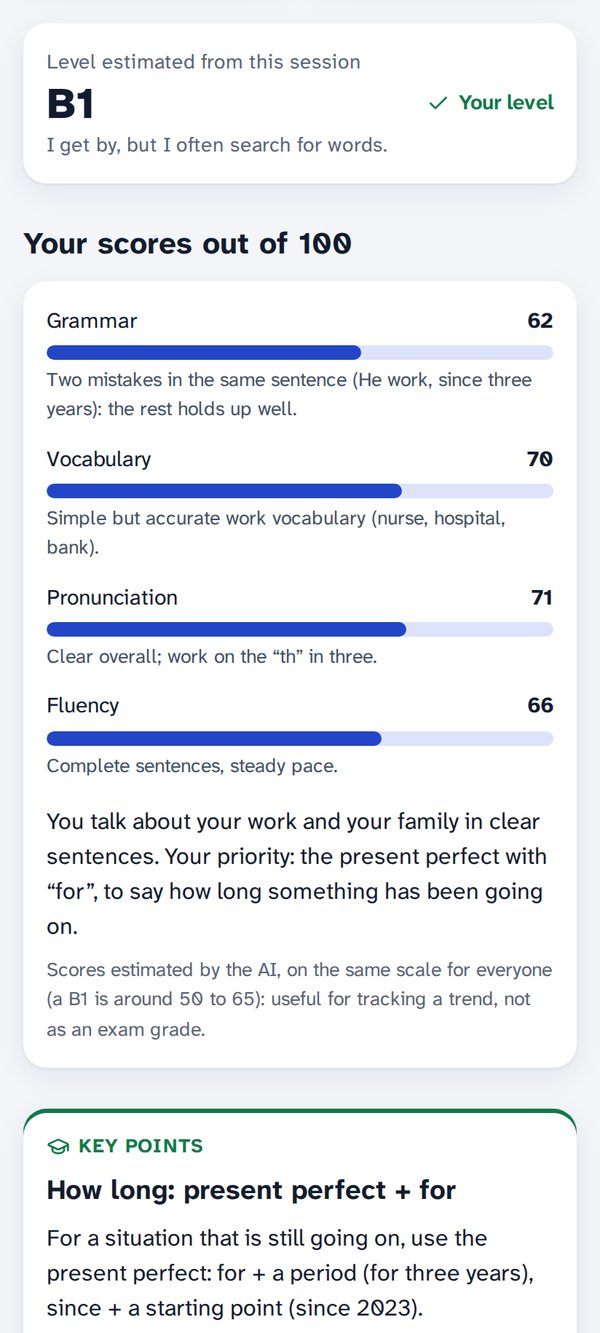
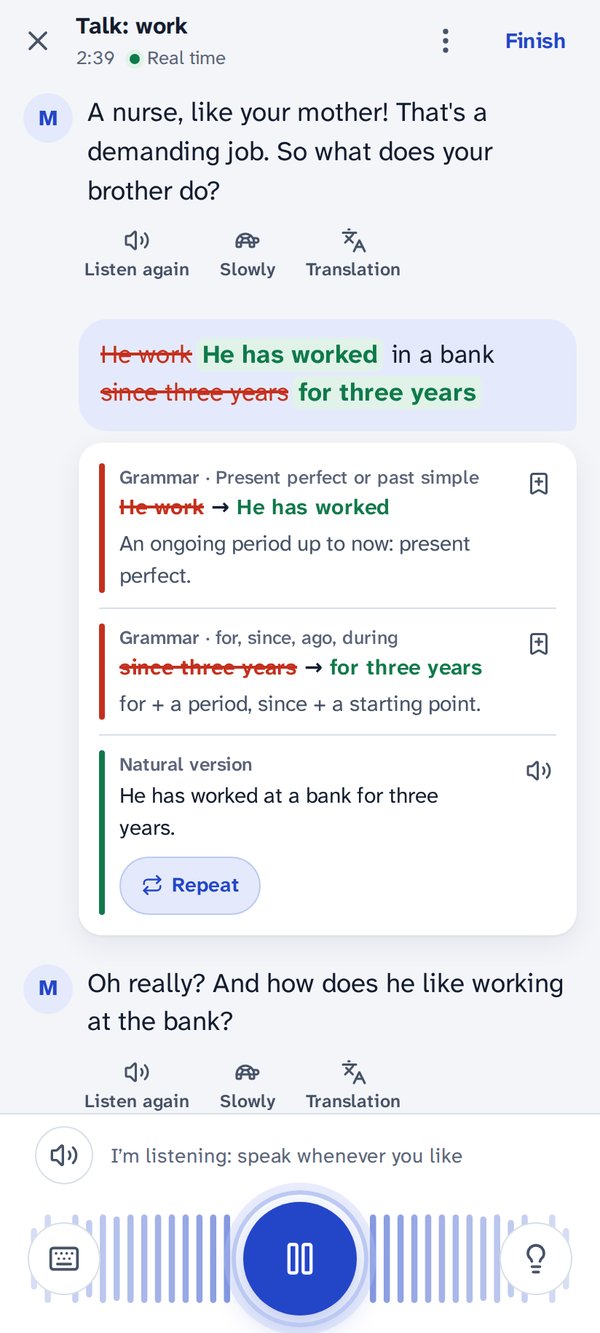
There are no corrections during the test. At the end you get an estimated band, a mark for each of the four criteria, feedback on each part and 3 tips. It is an AI estimate based on the published descriptors, not an official result. It works in your phone's browser (Android, Chrome): an account with your email address, a free trial, then a subscription.
Goudilingua is not affiliated with IELTS (British Council, IDP, Cambridge).
Frequently asked questions
How long is the IELTS Speaking test?
11 to 14 minutes, in three parts, alone with one examiner.
Is the Speaking test different for Academic and General Training?
No, the Speaking test is the same for both.
Can I take notes?
Yes, during the one-minute preparation for Part 2. Write key words for each point on the card.
What band should I aim for?
It depends on your plans. Many universities often ask for 6.5 or 7, but always check what the organisation concerned requires.
Is Goudilingua linked to IELTS?
No, Goudilingua is not affiliated with IELTS (British Council, IDP, Cambridge). The tests are original and the band is an estimate.

Speak English, fear-free. A little better every day.
7-day free trial, no card needed: your email address is all it takes. Ages 18 and up.