B1 Preliminary (PET) speaking test: format, examples and practice
The B1 Preliminary speaking test lasts 12 to 17 minutes for a pair of candidates and has four parts. You answer questions about yourself, describe a photo on your own for a minute, then discuss options with your partner and reach a decision. Here is how each part works and how to prepare.
7-day free trial, no card needed: your email address is all it takes. Ages 18 and up.
B1 Preliminary speaking test format
Part 1
Time: 2 to 3 min
What you do: Personal questions: studies, work, free time, routines
Part 2
Time: 2 to 3 min
What you do: Each candidate describes one colour photograph for about 1 minute
Part 3
Time: 2 to 3 min
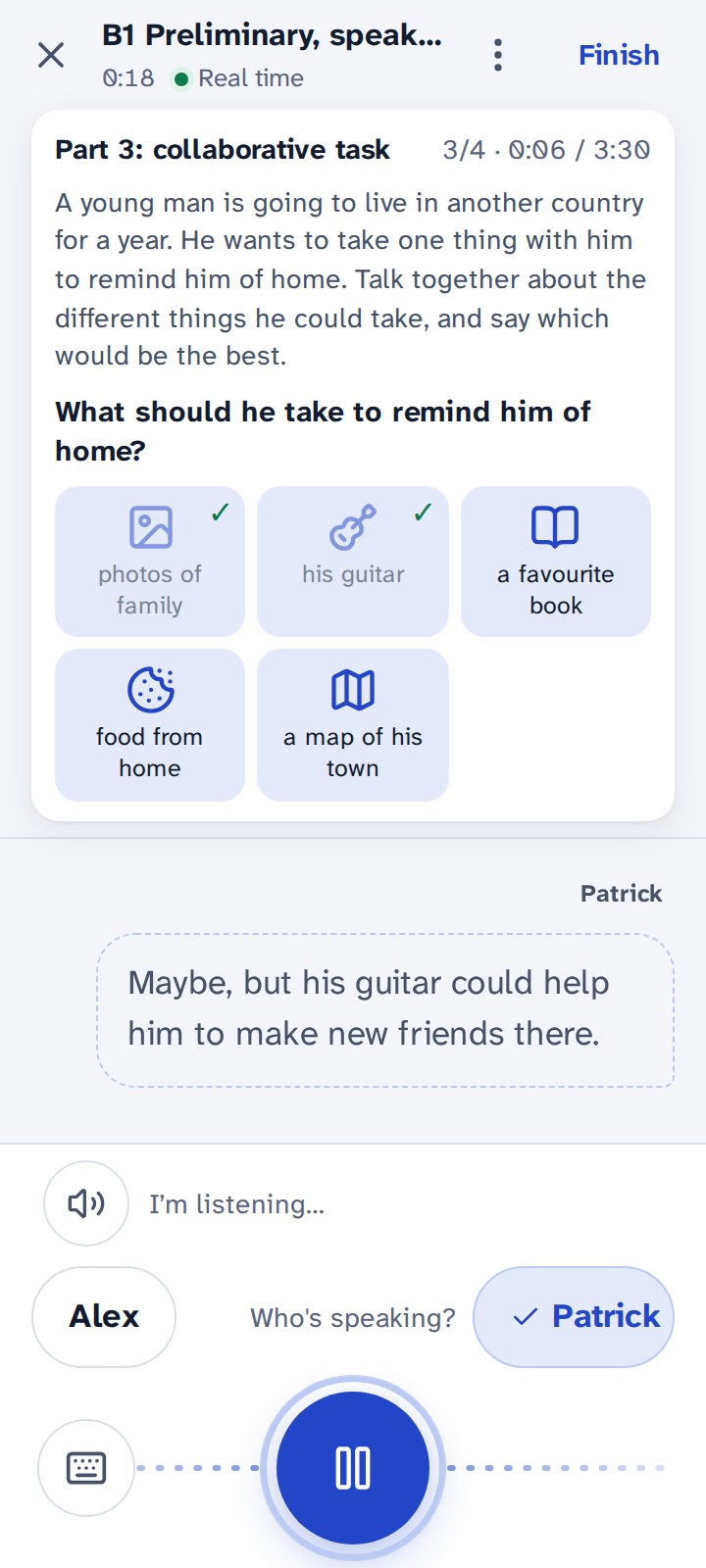
What you do: Collaborative task: a situation, about five pictures of options, decide which is best
Part 4
Time: 3 min
What you do: Discussion questions linked to the Part 3 topic
Part 2. You speak alone for about a minute. Describe what you see: the people, what they are doing, the place and the atmosphere. If you don't know a word, talk around it: “a kind of…”, “something you use to…”.
Part 3. The examiner describes a situation, for example: a friend wants to get fit, and here are some ideas. You and your partner talk about the options, give reasons and try to agree on the best one. You don't have to agree in the end.
Part 4. The examiner asks more general questions on the same topic. Share your ideas and respond to your partner's.
What the examiners assess and how scoring works
- Grammar and Vocabulary: correct sentences and enough vocabulary for the topic.
- Discourse Management: developed answers, linked with words like because, so, but and also.
- Pronunciation: you are easy to understand and stress words correctly.
- Interactive Communication: you keep the discussion going with your partner.
- Global Achievement: an overall mark from the interlocutor.
The speaking paper gets its own score on the Cambridge English Scale; your final exam result is the average of all the papers.
| Score | Result |
|---|---|
| 160 to 170 | Grade A (B2 level) |
| 153 to 159 | Grade B (B1 level) |
| 140 to 152 | Grade C (B1 level) |
| 120 to 139 | A2 certificate |
Example questions
- What do you enjoy doing in your free time?
- Tell us about a place you like to visit in your town.
- Now, here is your photograph. It shows people shopping at a market. Please tell us what you can see.
- A young man wants to get fit. Talk together about the different things he could do and say which would be best.
- Do you think people today do enough exercise? Why or why not?
Useful phrases
- Describing a photo: In this picture I can see…, On the left / in the background…, It looks like…, They might be…
- Suggesting: What about…?, I think … is a good idea because…
- Reacting: I agree with you., That's true, but…, I'm not sure about that.
- Deciding: So, shall we choose…?, I think the best one is…
Example for Part 2: “In this picture I can see a family in a kitchen. I think they're cooking dinner together. The father is cutting vegetables and the girl is helping him. They look happy. It's probably the weekend, because everyone is at home.”
Common mistakes
- Stopping after 20 seconds in Part 2. Keep going: describe, then guess who the people are and what happens next.
- Choosing the best option in Part 3 straight away. Discuss several options first.
- Dominating the discussion. Leave space for your partner and ask “What do you think?”
- Answering Part 4 questions with “yes” or “no” only. Give a reason or a personal example.
- Using the present simple for actions in a photo: say they're cooking, not “they cook”.
Tips for the day
- Listen carefully to the situation in Part 3: your choice must fit it.
- If you don't understand a question, ask the examiner to repeat it.
- Use simple linking words to make your answers longer and clearer.
- Stay calm if you make a mistake: correct it if you can, then move on.
Practising with Goudilingua
In Goudilingua, you choose B1 Preliminary and an original test. The AI examiner speaks to you out loud, with a timer for each part, a photo for Part 2 and pictures of the options for Part 3. For the paired task, a virtual partner with their own voice discusses with you; you can also take the test with a friend on the same phone.
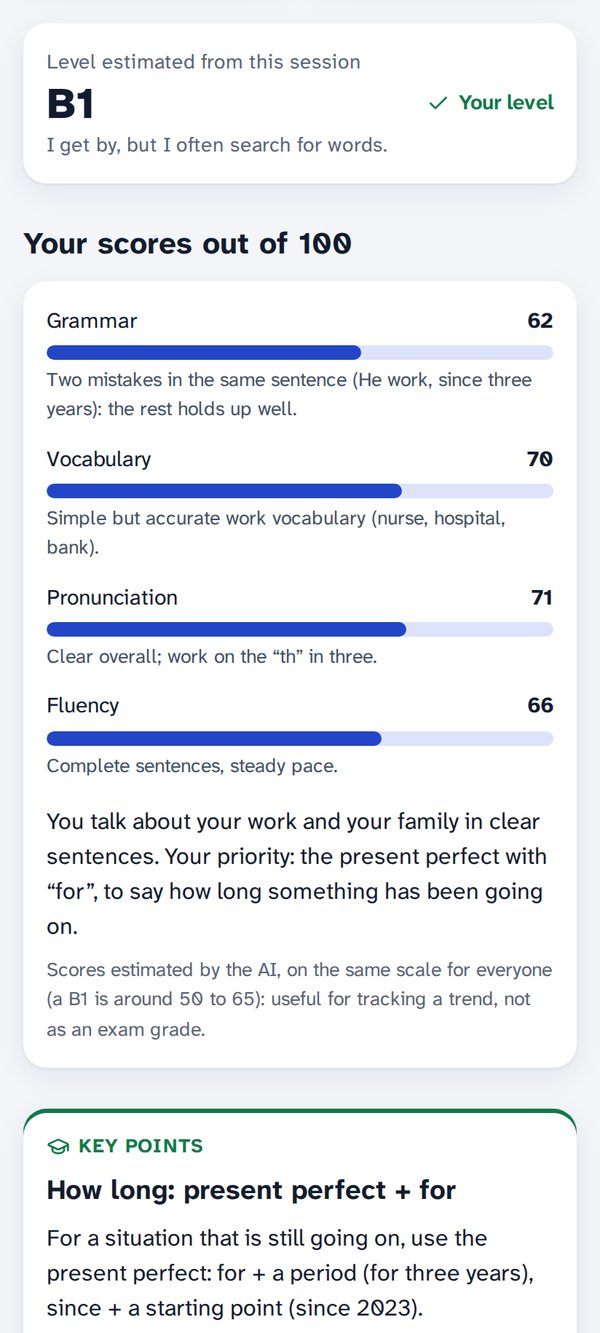
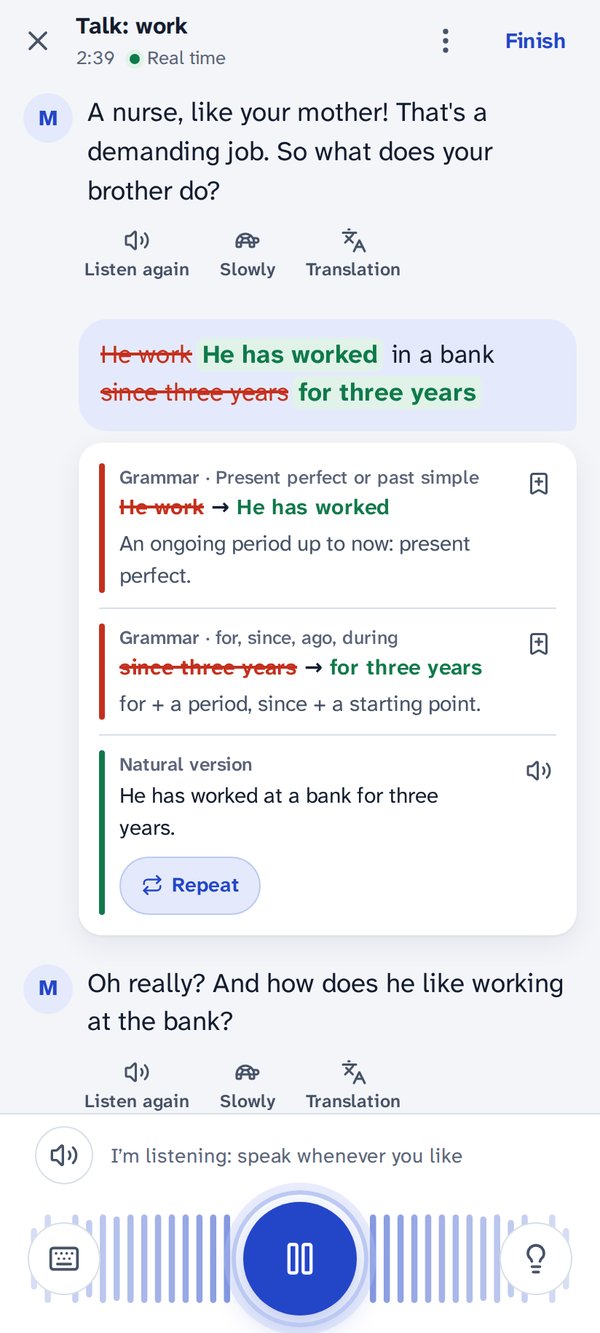
There are no corrections during the test. At the end you get an estimated Cambridge English Scale score, a mark for each of the five criteria, feedback on each part and 3 tips. It is an AI estimate, not an official result. It works in your phone's browser (Android, Chrome): an account with your email address, a free trial, then a subscription.
Goudilingua is not affiliated with Cambridge University Press & Assessment.
Frequently asked questions
How long is the B1 Preliminary speaking test?
12 to 17 minutes for a pair of candidates, in four parts.
How long do I speak on my own?
About one minute in Part 2, describing a photo. The rest of the time you answer the examiner or talk with your partner.
Photo, picture or photograph: what is Part 2 about?
They all mean the same thing. Cambridge's official wording says "photograph"; people also say photo, picture or image. In Part 2 you describe one colour picture for about a minute.
Do I have to agree with my partner?
No. You can politely disagree and explain why. What matters is having a real discussion.
What score do I need to pass B1 Preliminary?
At least 140 on the Cambridge English Scale for B1 level. From 160 to 170 you get grade A, which corresponds to B2 level.
Is Goudilingua linked to Cambridge?
No, Goudilingua is not affiliated with Cambridge University Press & Assessment. The tests are original and the score is an estimate.

Speak English, fear-free. A little better every day.
7-day free trial, no card needed: your email address is all it takes. Ages 18 and up.