C1 Advanced (CAE) speaking test: format, examples and practice
The C1 Advanced speaking test lasts 15 minutes for a pair of candidates. You are expected to speak fluently and with nuance: choose two of three pictures and discuss them, lead a discussion to a decision, then explore abstract questions. Here is the format, how it is marked and what makes the difference at this level.
7-day free trial, no card needed: your email address is all it takes. Ages 18 and up.
C1 Advanced speaking test format
Part 1: interview
Time: 2 min
What you do: Questions about you, your interests and plans
Part 2: long turn
Time: 4 min
What you do: Three pictures: choose two and answer two questions (about 1 min), then respond to your partner's pictures (about 30 s)
Part 3: collaborative task
Time: 4 min
What you do: A question with five prompts: 2 min of discussion, then 1 min to reach a decision
Part 4: discussion
Time: 5 min
What you do: More abstract questions linked to the Part 3 topic
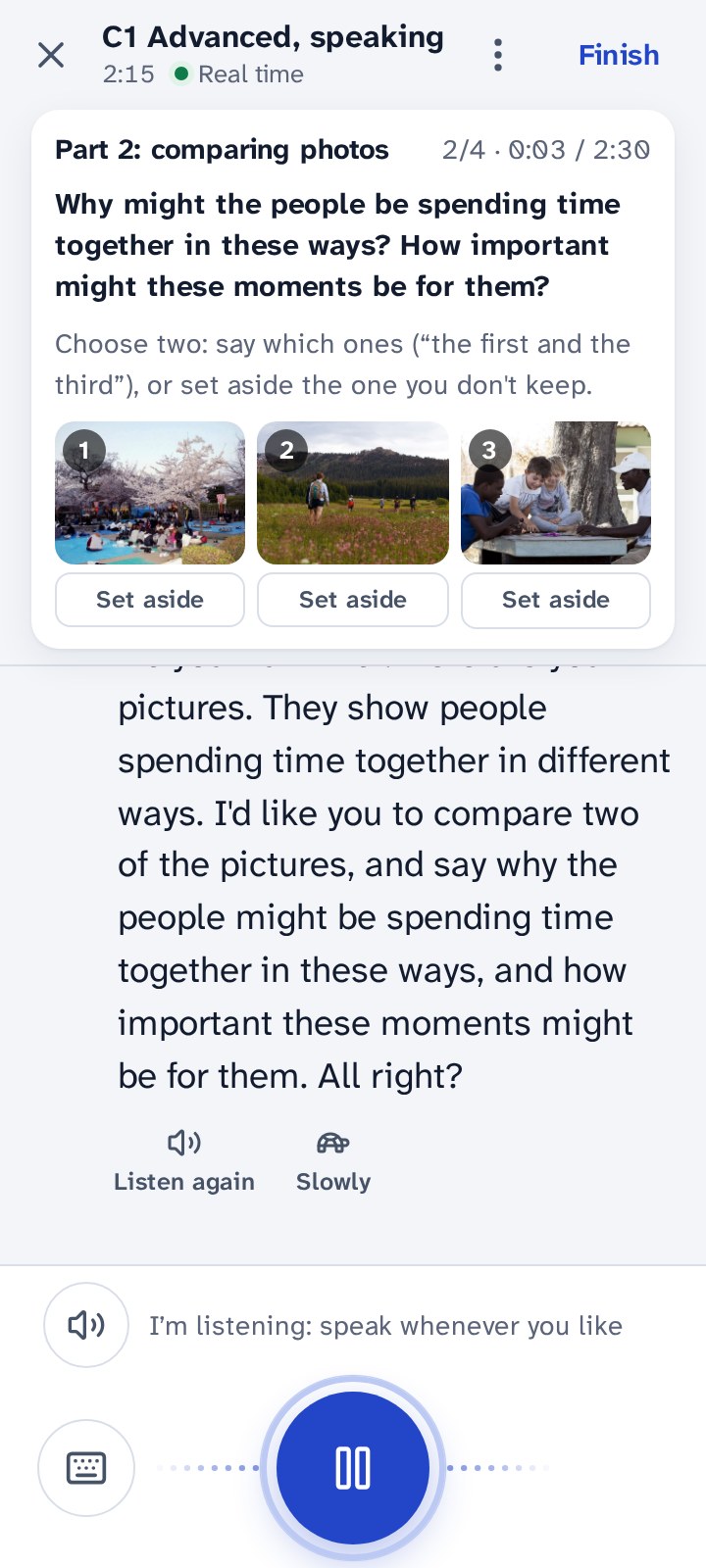
Part 2. You see three pictures and two questions, for example “Why might these people be working together? How might they be feeling?”. You choose two pictures and answer both questions in about a minute. Don't describe: analyse, speculate and compare.
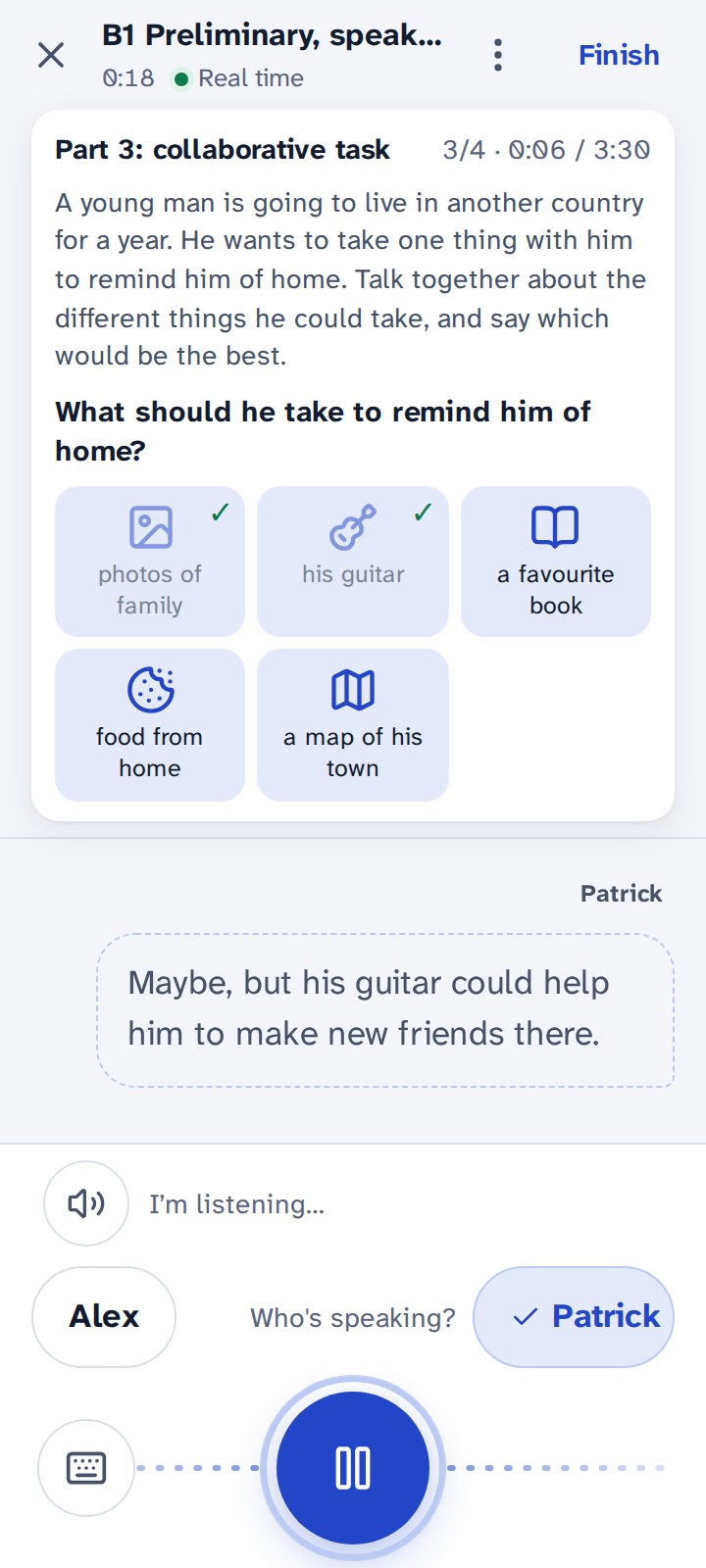
Part 3. A question in the centre, five prompts around it. For 2 minutes you explore them in depth; then you have 1 minute to reach a decision (for example, which prompt would have the greatest impact).
Part 4. Five minutes of discussing ideas. This is where nuance, examples and the ability to develop a point of view count most.
What the examiners assess and how scoring works
- Grammatical Resource: a range of complex structures, used with control.
- Lexical Resource: precise vocabulary and idiomatic language used appropriately.
- Discourse Management: extended, coherent, well-structured contributions.
- Pronunciation: clarity, word and sentence stress, intonation.
- Interactive Communication: moving the discussion forward, negotiating, concluding.
- Global Achievement: an overall mark from the interlocutor.
The speaking paper gets its own score on the Cambridge English Scale; your final result is the average of all the papers.
| Score | Result |
|---|---|
| 200 to 210 | Grade A (C2 level) |
| 193 to 199 | Grade B (C1 level) |
| 180 to 192 | Grade C (C1 level) |
| 160 to 179 | B2 certificate |
Example questions
- What do you find most rewarding about the work or studies you're doing at the moment?
- Here are your pictures. They show people making difficult decisions. Choose two of the pictures and say what the people might be considering, and how they might feel afterwards.
- Which of these situations do you think would be the hardest to deal with?
- Here are some factors that can influence the way people choose a career. Talk to each other about how much influence these factors might have.
- Now you have about a minute to decide which factor is likely to be the least important in the future.
- Is it realistic to expect a job to be both well paid and meaningful?
Useful phrases at C1 level
- Speculating: They're likely to be…, I'd hazard a guess that…, It could well be that…
- Adding nuance: To a certain extent…, That said…, It depends to a large degree on…
- Involving your partner: Would you go along with that?, Where do you stand on…?
- Refocusing: Coming back to the question…, So, weighing it all up…
Example for Part 2: “I'll go for the first and the third pictures. The surgeons are clearly working under a lot of pressure, so they'd need to trust each other completely, whereas the volunteers planting trees seem far more relaxed. I'd imagine they're doing it because they care about their local area, and they probably feel quite proud of what they've achieved.”
Common mistakes
- Answering only one of the two questions in Part 2.
- Forcing idioms into answers. A misused idiom does more harm than good; precision matters more.
- Rushing to a decision in Part 3 instead of exploring the prompts with examples and consequences.
- Short, safe answers in Part 4. At C1 the examiner wants developed arguments and nuance.
- Word stress in word families: eCOnomy but ecoNOmic, POlitics but poLItical.
Tips for the day
- Choose your two pictures quickly: the ones you have the most to say about.
- Build on what your partner says rather than taking turns giving separate opinions.
- Don't be afraid to change your mind in the discussion; explain why.
- If you lose your thread, refocus: “Coming back to the question…”.
Practising with Goudilingua
In Goudilingua, you choose C1 Advanced and an original test. The AI examiner speaks to you out loud, with a timer for each part, the three pictures with their two questions and the Part 3 mind map. For the paired task, a virtual partner with their own voice discusses with you; you can also take the test with a friend on the same phone.
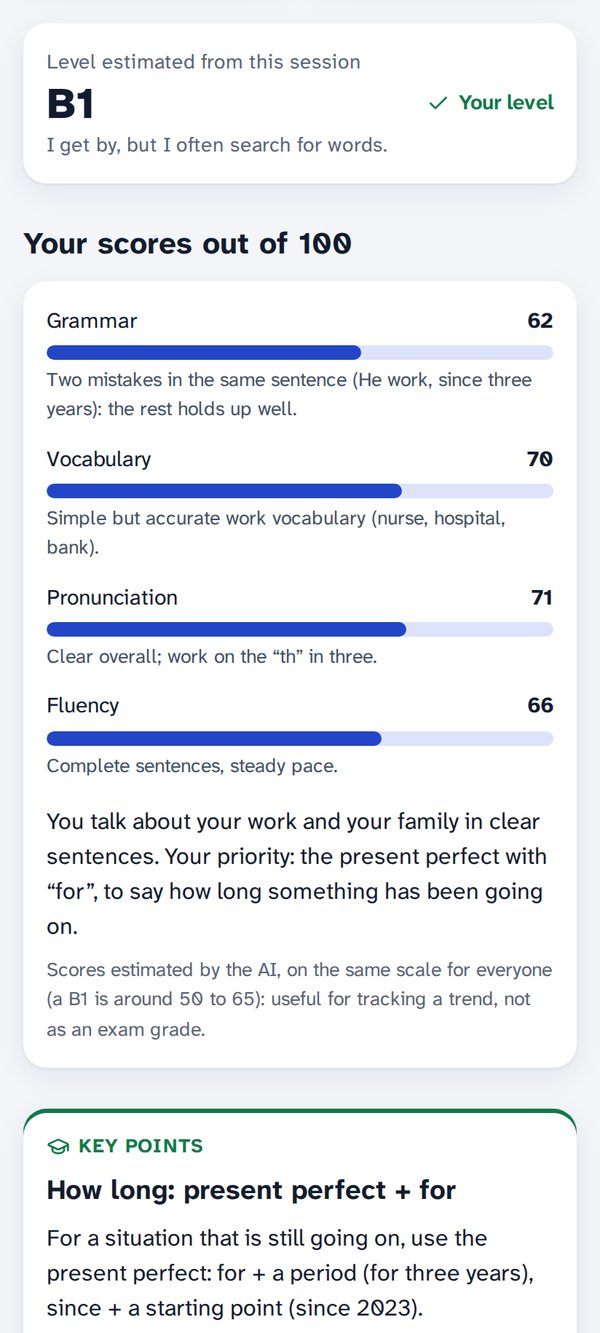
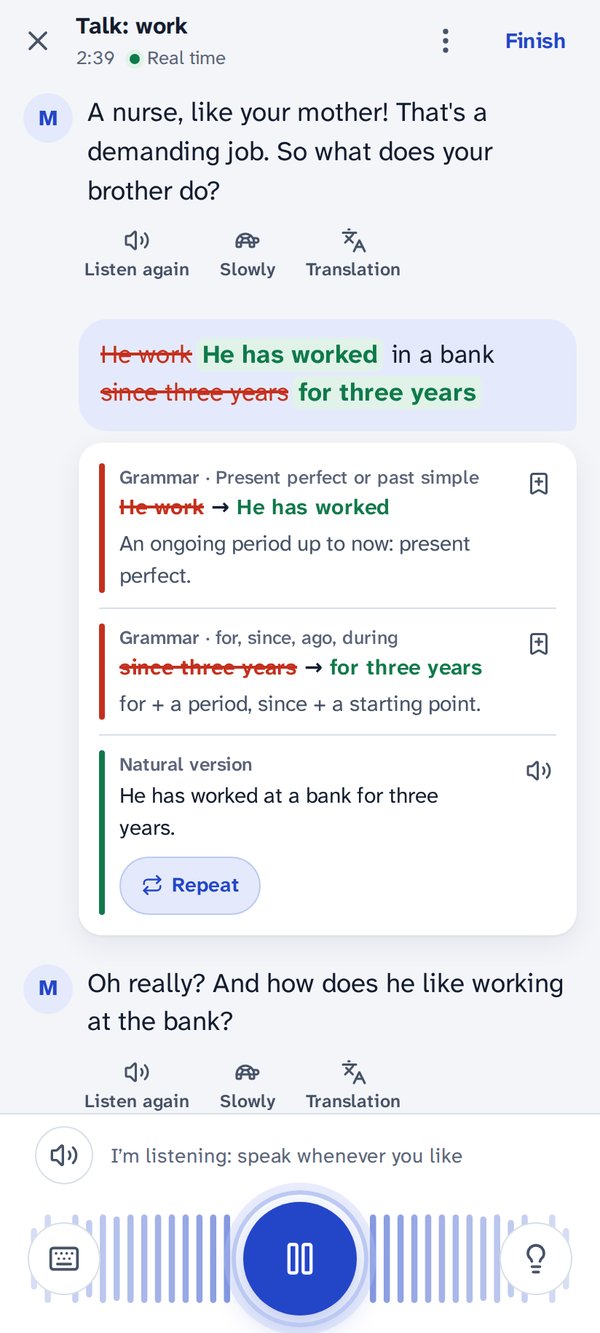
There are no corrections during the test. At the end you get an estimated Cambridge English Scale score for speaking, a mark for each of the six criteria, feedback on each part and 3 tips. It is an AI estimate, not an official result. It works in your phone's browser (Android, Chrome): an account with your email address, a free trial, then a subscription.
Goudilingua is not affiliated with Cambridge University Press & Assessment.
Frequently asked questions
How long is the C1 Advanced speaking test?
15 minutes for a pair of candidates, in four parts.
How is it different from the B2 First speaking test?
The format is similar, but in Part 2 you choose two of three pictures and answer two questions, Part 4 lasts 5 minutes, and more precision and nuance are expected.
What score do I need to pass C1 Advanced?
At least 180 on the Cambridge English Scale for C1 level. From 200 to 210 you get grade A, which corresponds to C2 level.
Pictures, photos or photographs: is it the same Part 2?
Yes. Cambridge's official wording says "pictures"; people also say photos, photographs or images. In Part 2 you choose two of three pictures and answer two questions in about a minute.
Should I use lots of idioms?
Only if they come naturally and are used correctly. Precision and range matter more than memorised expressions.
Is Goudilingua linked to Cambridge?
No, Goudilingua is not affiliated with Cambridge University Press & Assessment. The tests are original and the score is an estimate.

Speak English, fear-free. A little better every day.
7-day free trial, no card needed: your email address is all it takes. Ages 18 and up.