B2 First (FCE) speaking test: format, examples and practice
The B2 First speaking test lasts 14 minutes for a pair of candidates. You compare two photos, discuss a question with your partner using five written prompts, then talk about wider issues. Here is each part in detail, how you are marked, and phrases you can use straight away.
7-day free trial, no card needed: your email address is all it takes. Ages 18 and up.
B2 First speaking test format
Part 1: interview
Time: 2 min
What you do: Questions about you: studies, work, free time, plans
Part 2: long turn
Time: 4 min
What you do: Compare two photos and answer a printed question (about 1 min), then answer a short question about your partner's photos (about 30 s)
Part 3: collaborative task
Time: 4 min
What you do: A question with five written prompts: 2 min of discussion, then 1 min to reach a decision
Part 4: discussion
Time: 4 min
What you do: Wider questions linked to the Part 3 topic
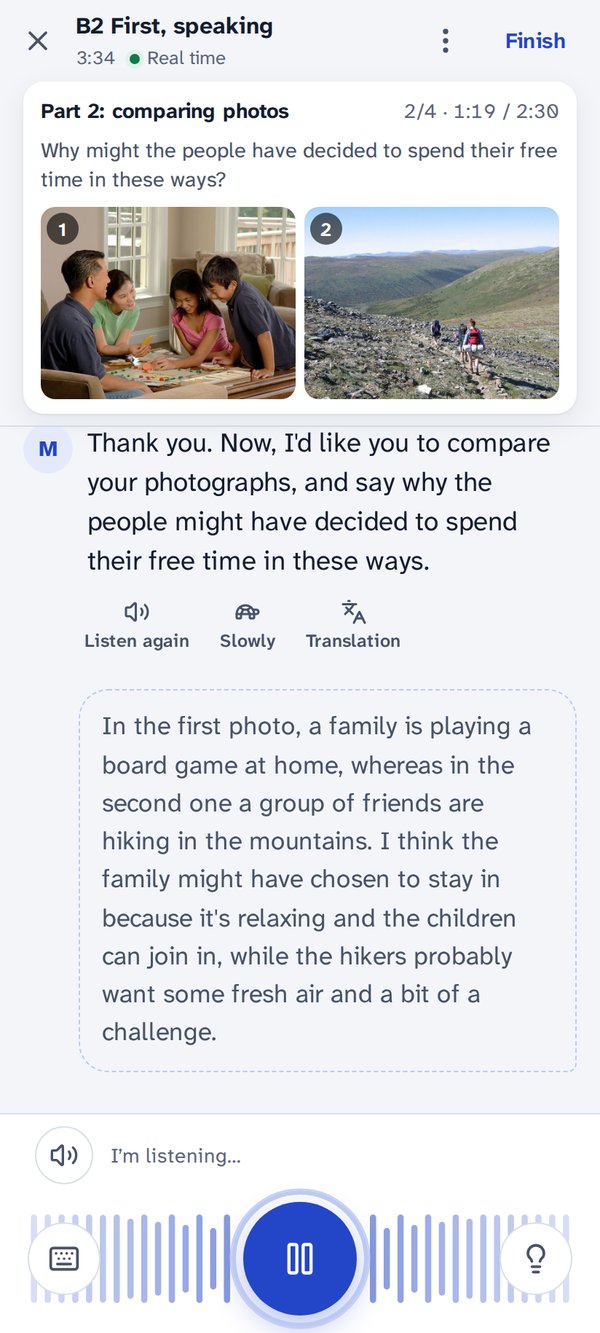
Part 2. The classic trap is describing each photo in detail. You need to compare them (similarities, differences) and, above all, answer the question printed above them, for example “Why might these people have chosen to spend their free time in these ways?”. Then the examiner asks you a short question about your partner's photos: answer in about 30 seconds.
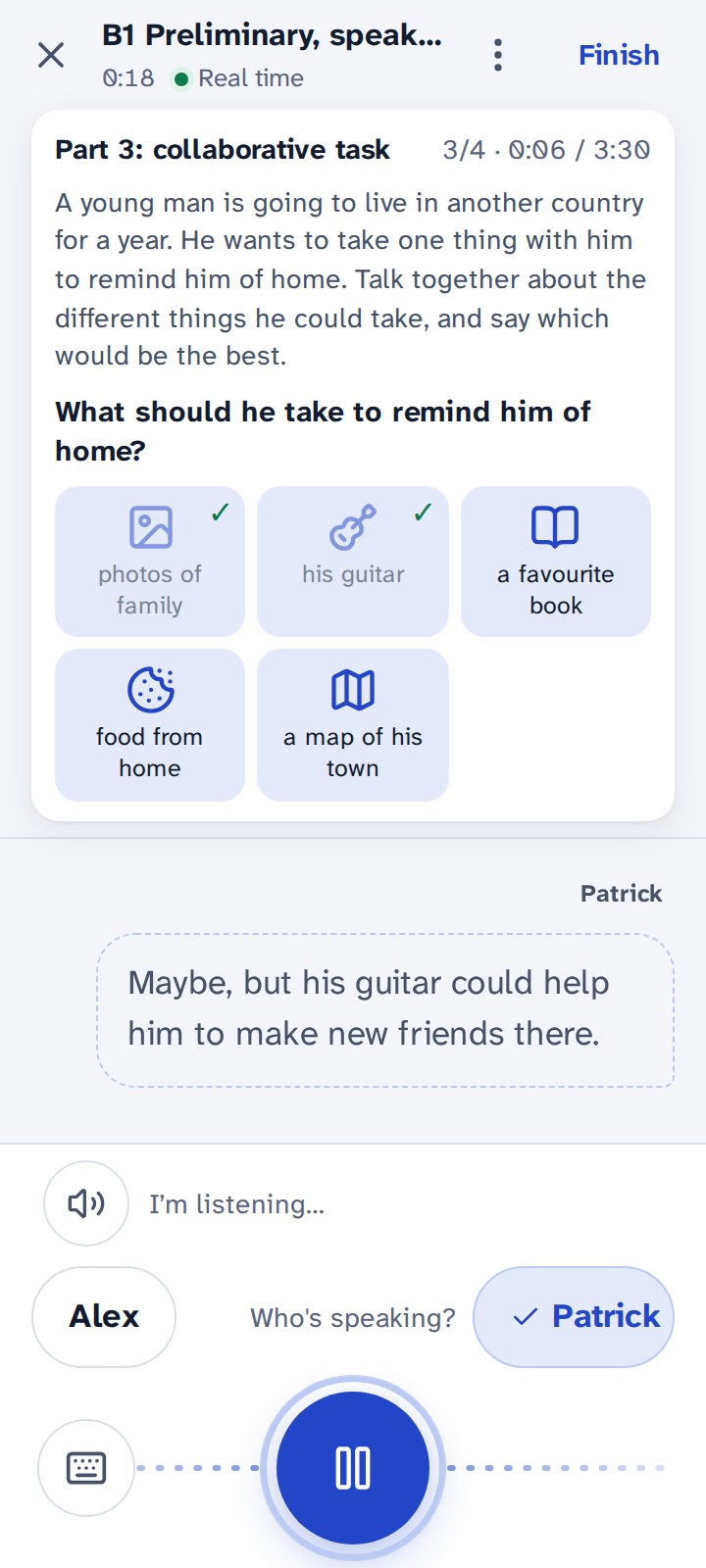
Part 3. The question sits in the middle of a mind map with five prompts around it. For 2 minutes you discuss the prompts, one by one, without rushing. Then the examiner gives you 1 minute to reach a decision, for example which prompt is the most important.
Part 4. Broader opinion questions. This is where you add nuance and respond to what your partner says.
What the examiners assess and how scoring works
- Grammar and Vocabulary: range and accuracy (tenses, conditionals, precise words).
- Discourse Management: extended, organised answers without too much hesitation.
- Pronunciation: sounds, word stress and intonation.
- Interactive Communication: starting, developing and concluding the discussion.
- Global Achievement: an overall mark from the interlocutor.
The speaking paper gets its own score on the Cambridge English Scale; your final result is the average of all the papers.
| Score | Result |
|---|---|
| 180 to 190 | Grade A (C1 level) |
| 173 to 179 | Grade B (B2 level) |
| 160 to 172 | Grade C (B2 level) |
| 140 to 159 | B1 certificate |
Example questions
- What do you enjoy most about the place where you live?
- Here are your photographs. They show people learning new skills. Compare the photographs and say what the people might find difficult about learning in these ways.
- Which of these photos shows the more relaxing way to travel?
- Here are some things that can help people feel less stressed. Talk to each other about how useful these things might be.
- Now you have about a minute to decide which one would help young people the most.
- Some people say we spend too much time on our phones. What do you think?
Useful phrases for B2 First speaking
- Comparing: Both pictures show…, whereas in the second one…, Unlike the first photo…
- Speculating: They might be…, It looks as if…, I'd imagine that…
- Starting Part 3: Shall we start with…?, How do you feel about…?
- Adding nuance: I see your point, but…, That's true to some extent.
- Concluding: So, are we agreed that…?, Let's go for…
Example for Part 2: “Both photos show people relaxing, but in very different ways. In the first one, a group of friends are playing football in a park, whereas in the second one a woman is reading alone at home. I'd say the friends want some exercise and company, while the woman probably needs some peace and quiet after a busy week.”
Common mistakes
- Describing instead of comparing in Part 2, and forgetting the printed question.
- Making the decision too early in Part 3. Discuss first; decide in the final minute.
- Monologues in the paired task. Ask “What's your view?” and build on your partner's ideas.
- Memorised answers that don't fit the question. Examiners notice.
- Uncountable nouns: say information and some advice, not “informations” or “an advice”.
- Word stress: PHOtograph but phoTOgraphy, deVElop, enVIronment.
Tips for the day
- Keep an eye on the time in Part 2: about one minute goes quickly, so get to the question early.
- If you can't find a word, paraphrase: “the thing you use to…”.
- Use a range of structures naturally: a conditional, a modal verb for speculation, a present perfect.
- Stay involved when your partner is speaking: you will be asked about their photos.
Practising with Goudilingua
In Goudilingua, you choose B2 First and an original test. The AI examiner speaks to you out loud, with a timer for each part, pairs of photos with their question, and the Part 3 mind map. For the paired task, a virtual partner with their own voice discusses with you; you can also take the test with a friend on the same phone.
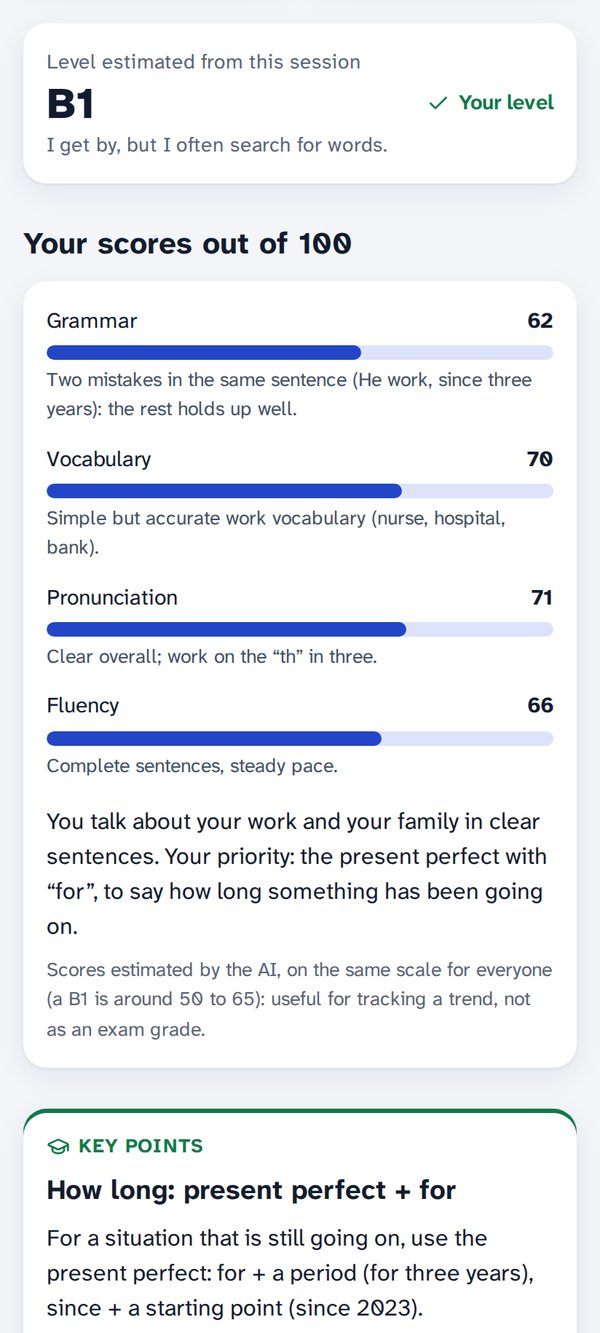
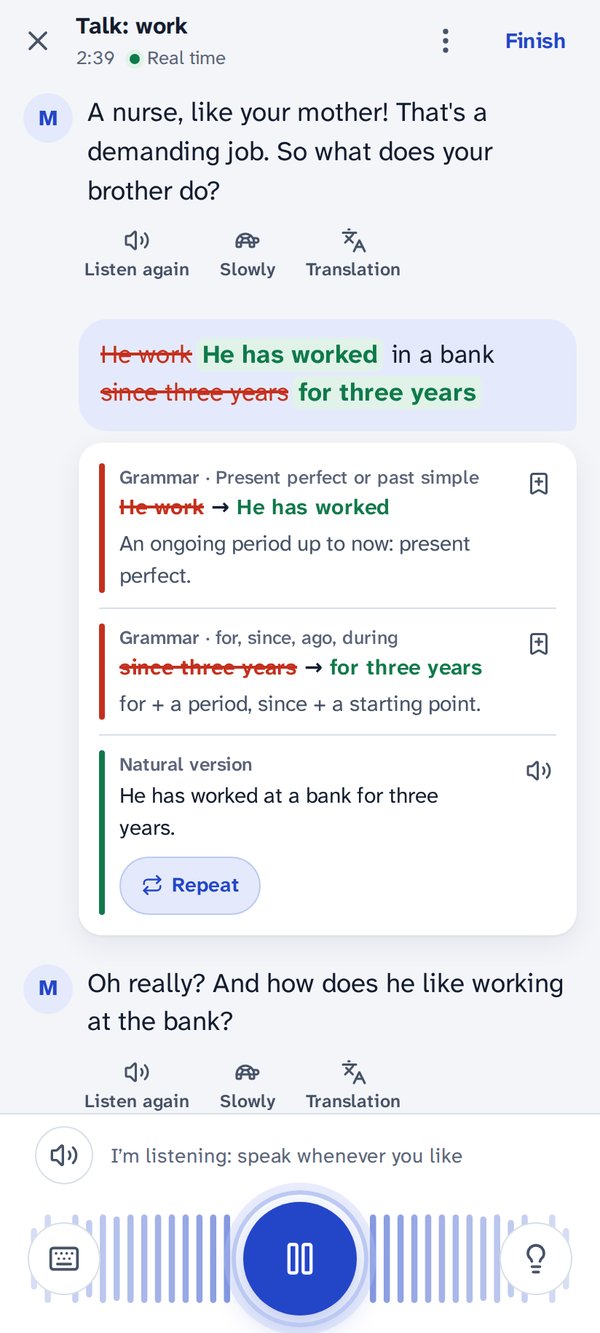
There are no corrections during the test, just like the real exam. At the end you get an estimated Cambridge English Scale score for speaking, a mark for each criterion, feedback on each part and 3 tips. It is an AI estimate, not an official result. It works in your phone's browser (Android, Chrome): an account with your email address, a free trial, then a subscription.
Goudilingua is not affiliated with Cambridge University Press & Assessment.
Frequently asked questions
How long is the B2 First speaking test?
14 minutes for a pair of candidates, in four parts.
Should I describe the photos in detail in Part 2?
No. Compare them and answer the question printed above them. A detailed description of each photo is not enough.
Do we have to agree in Part 3?
You should try to reach a decision in the final minute, but you can disagree. What matters is the quality of the discussion.
What score do I need to pass B2 First?
At least 160 on the Cambridge English Scale for B2 level. From 180 to 190 you get grade A, which corresponds to C1 level. Your final result is the average of all the papers.
Is Goudilingua linked to Cambridge?
No, Goudilingua is not affiliated with Cambridge University Press & Assessment. The tests are original and the score is an estimate.

Speak English, fear-free. A little better every day.
7-day free trial, no card needed: your email address is all it takes. Ages 18 and up.