B2 First Speaking Part 2: compare two photos in one minute
In Part 2 of the B2 First Speaking test, you talk on your own for one minute: the examiner gives you two photos and a question printed above them. You need to compare the photos and answer the question, not describe them one by one. Then you answer a short question about the other candidate's photos in about 30 seconds. Here is how it works, a simple method, ready-to-use phrases and how to practise out loud with an AI examiner.
7-day free trial, no card needed: your email address is all it takes. Ages 18 and up.
How Part 2 works
The instructions
Time: 15 s
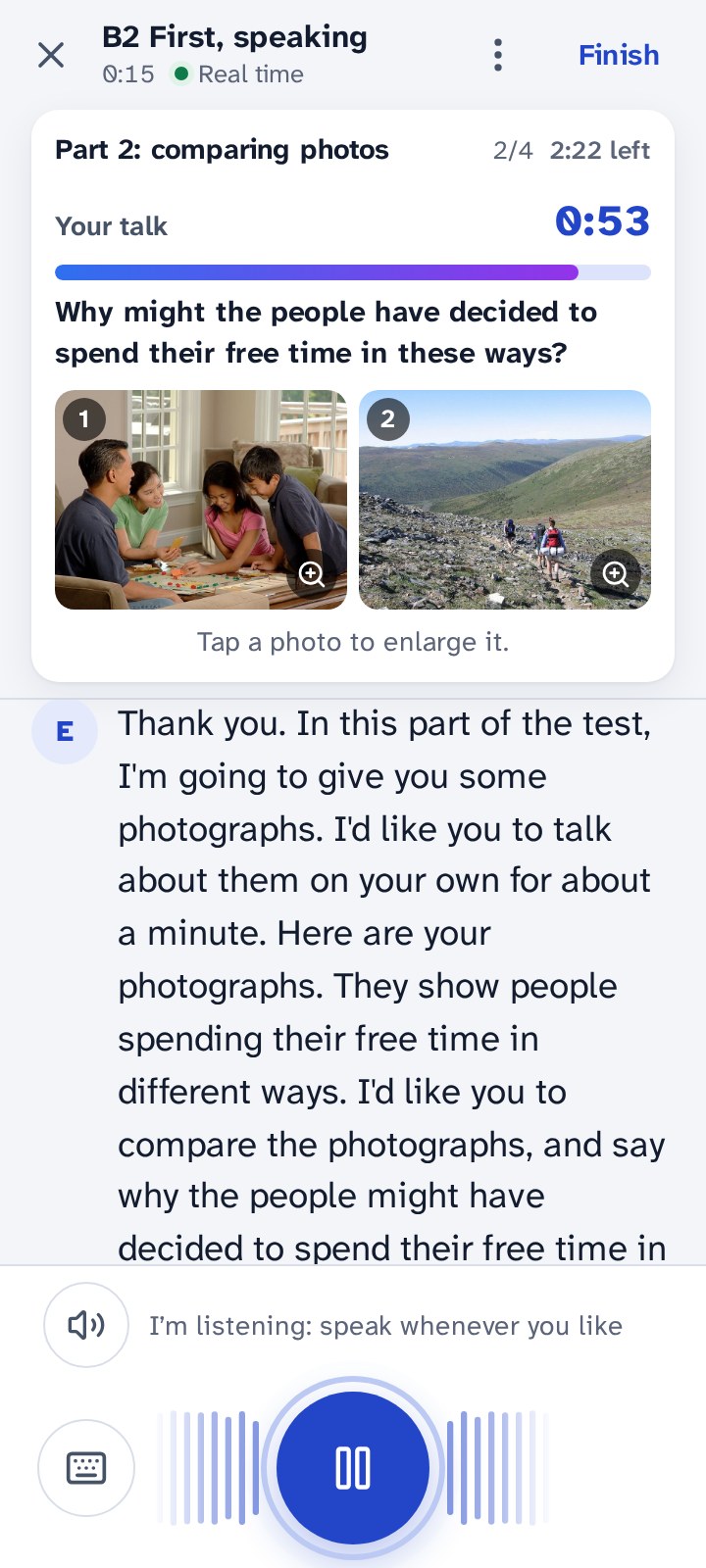
What you do: The examiner gives you two photos and reads the question printed above them, for example: “Why might the people have decided to spend their free time in these ways?”
Your long turn
Time: 1 min
What you do: Compare the two photos and answer the question, on your own, without being interrupted.
The other candidate's photos
Time: 30 s
What you do: After their long turn, the examiner asks you a short question about their photos, for example: “Which of these activities would you prefer? Why?”
The part takes about 4 minutes for two candidates: each of you has a one-minute long turn, then answers a 30-second question about the other's photos.
Compare, don't describe: a one-minute method
- What the photos have in common (about 10 seconds): “Both photos show people spending their free time…”.
- How they differ (about 20 seconds): the place, the atmosphere, the people, what they are doing.
- The answer to the question (about 30 seconds, the most important part): speculate with might, could, probably, I imagine, and give a reason for each photo.
- If you have time left: your preference, in one sentence.
Example: “Both photos show people spending their free time together, but in the first one a family is playing a board game at home, whereas in the second one some friends are hiking in the mountains. I imagine the family has chosen to stay in because it's relaxing and the children can join in, while the hikers probably wanted some fresh air and a bit of a challenge.”
What the examiner says
- In this part of the test, I'm going to give you some photographs. I'd like you to talk about them on your own for about a minute.
- Here are your photographs. They show people spending their free time in different ways.
- I'd like you to compare the photographs, and say why the people might have decided to spend their free time in these ways.
- Thank you. Which of these activities would you prefer? Why?
Useful phrases for comparing two photos or pictures
- Comparing: “Both pictures show…”, “In the first photo…, whereas in the second one…”, “One thing they have in common is…”, “The main difference is that…”.
- Speculating: “They might be…”, “It looks as if…”, “I'd imagine that…”, “Perhaps they've just…”.
- Answering the question: “I think the main reason is probably…”, “That's why they might have chosen to…”.
- Buying a second: “Let me think…”, “That's an interesting question.”.
- The question about the other candidate's photos: “I'd prefer the second one, because…”, in two or three sentences, no more.
Common mistakes in Part 2
- Describing each photo in detail (“In the first picture I can see a man, a woman…”) instead of comparing them.
- Forgetting the printed question: it carries the most marks.
- Stopping after 30 seconds: the minute is your chance to show your English; add a reason, a guess, your preference.
- Answering for too long about the other candidate's photos: 30 seconds is enough.
- Repeating the same phrase (“I can see…” in every sentence): vary it with “It looks as if…”, “They seem to…”.
What the examiner assesses
- Grammar and Vocabulary: accurate, varied sentences and precise words to compare and speculate.
- Discourse Management: speaking for a minute in an organised way, with linking words (“whereas”, “while”, “on the other hand”).
- Pronunciation: clear sounds, word stress, natural intonation.
- Interactive Communication: mostly in Parts 3 and 4; here, answering what you are actually asked.
The second examiner, who does not speak, marks these four criteria; the one who asks the questions also gives an overall mark.
Practise Part 2 with Goudilingua
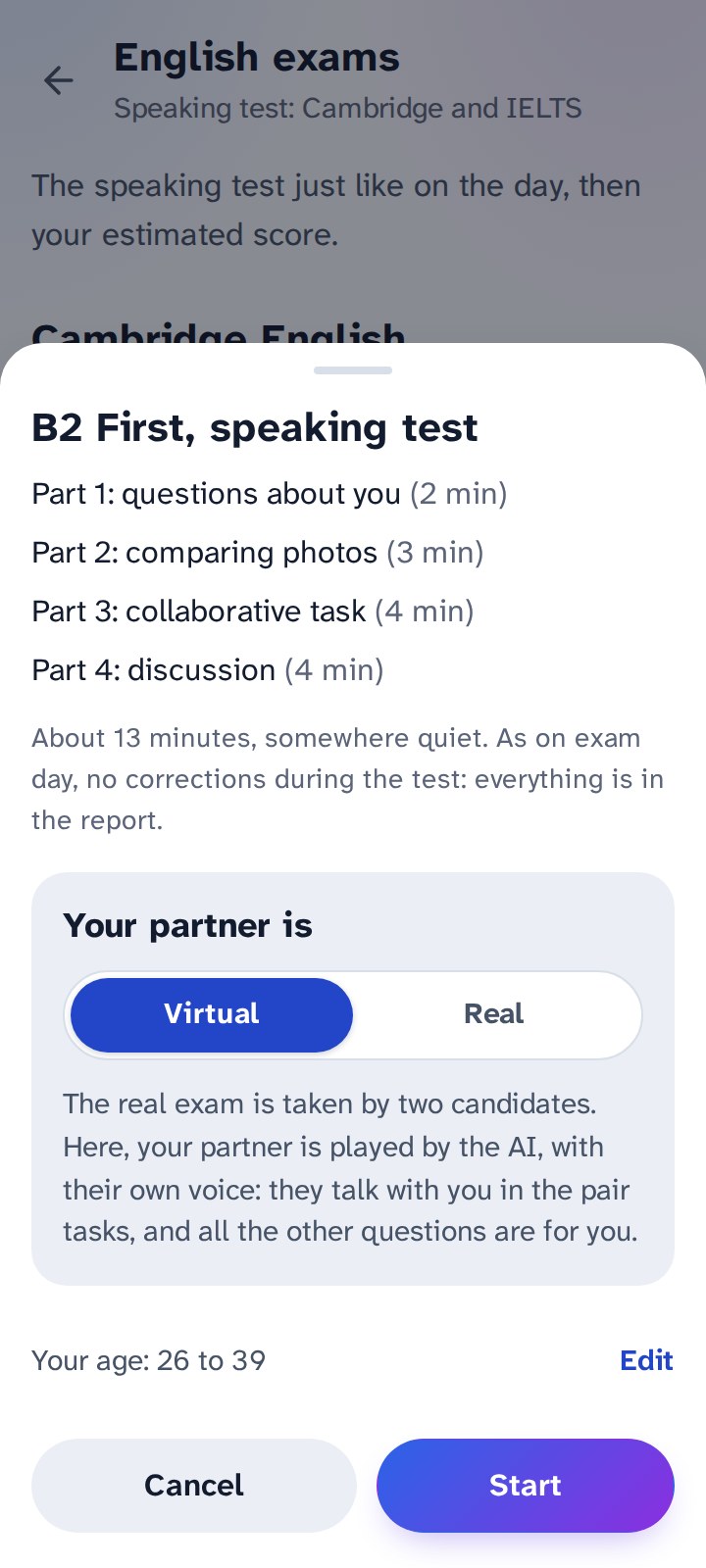
- An AI examiner, out loud: they give you the photos, read the question and let you speak for a minute without interrupting, just like on exam day.
- The photos on screen, the question printed above them and the time for your long turn counting down. Tap a photo, or spread two fingers on it, to enlarge it and see the details.
- If you get stuck: after a few seconds of silence, a small window reminds you of the task; then the examiner asks you a helping question, as a real examiner would.
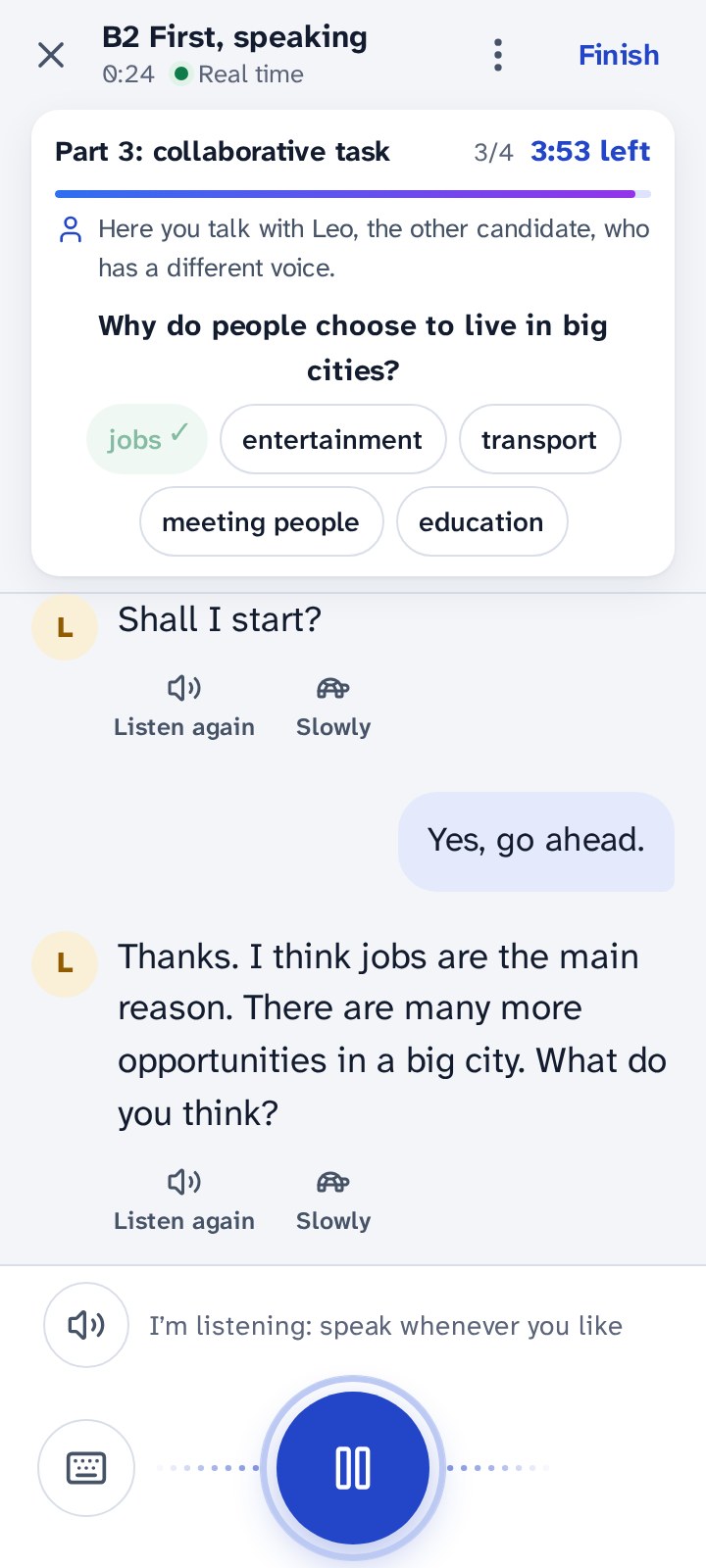
- On your own or in pairs: on your own, the other candidate is a virtual partner played by the AI with their own voice, and the examiner also asks you the 30-second question. In pairs, a real person takes the test with you on the same phone: each of you with your own photos and your own long turn.
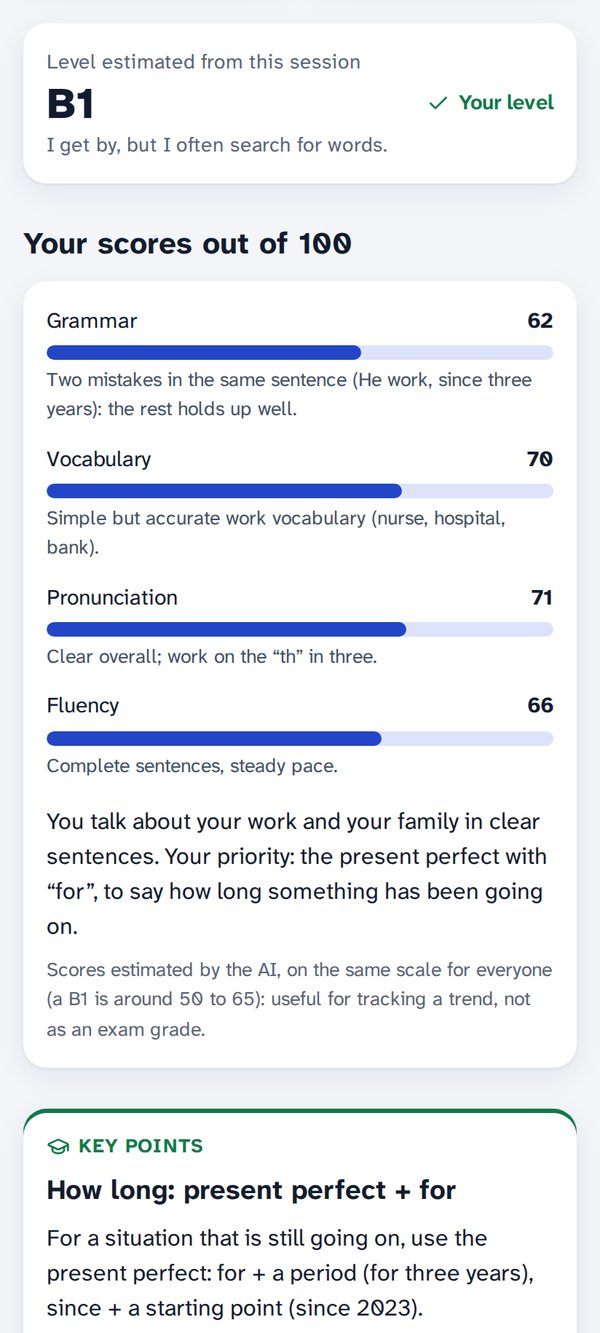
- A report at the end: your estimated score on the Cambridge English Scale (B2 First is reported from 140 to 190), a score for each criterion and your sentences corrected.
Nothing to download: everything works in the browser, on your phone or your computer. The app is for people aged 18 and over.
Frequently asked questions
How long is Part 2 of B2 First Speaking?
About 4 minutes for two candidates: a one-minute long turn each, then about 30 seconds to answer a question about the other candidate's photos.
Photos, pictures, photographs or images: is it the same task?
Yes. Cambridge's official wording says "photographs"; teachers and candidates also say photos, pictures or images. It is always Part 2: two pictures to compare in one minute.
Should I describe the photos?
No. Compare them and answer the question printed above them. A detailed description of each photo is not enough.
What if I run out of things to say before the minute is up?
Go back to the question: add a reason, a guess (“they might…”), or say which of the two situations you would prefer and why.
Can I practise Part 2 on my own?
Yes. In Goudilingua, an AI examiner gives you the photos and the question, lets you speak for a minute, then asks you the 30-second question. You can also practise in pairs, on the same phone.
Is Goudilingua linked to Cambridge?
No, Goudilingua is not affiliated with Cambridge University Press & Assessment. Tasks and photos are original or freely licensed, and the score is an estimate.

Speak English, fear-free. A little better every day.
7-day free trial, no card needed: your email address is all it takes. Ages 18 and up.