B2 First Speaking Part 3: the collaborative task, in pairs
In Part 3 of the B2 First Speaking test, you talk with the other candidate for two minutes about a question and five ideas, then you have one minute to try to reach a decision. What counts is the interaction: responding, building on each other's ideas and moving the discussion forward, not being right. Here is how it works, phrases for interacting, mistakes to avoid and how to practise, with a virtual partner or a real person.
7-day free trial, no card needed: your email address is all it takes. Ages 18 and up.
How Part 3 works
The instructions
Time: 15 s
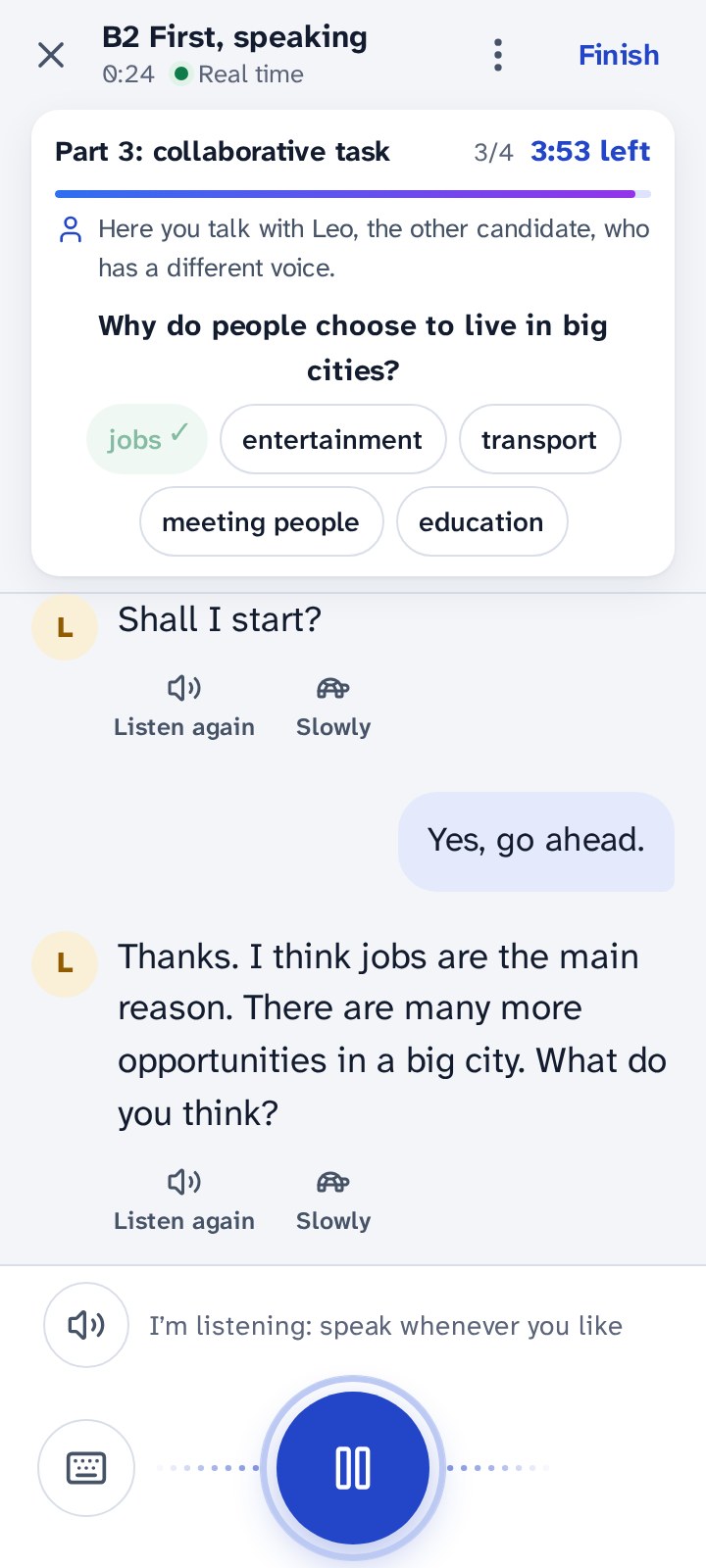
What you do: The examiner shows you a question surrounded by five ideas and reads it, for example: “Why do people choose to live in big cities?”, with jobs, entertainment, transport, meeting people, education.
The discussion
Time: 2 min
What you do: You talk about the ideas together, giving reasons and reacting to what the other person says.
The decision
Time: 1 min
What you do: The examiner asks a second question, for example: “Which reason do you think is the most important for young people?”; you try to agree.
You don't have to agree: a polite, well-argued disagreement counts as much as an agreement. The examiner does not speak during your discussion.
How to discuss well in pairs
- Get things started: “Shall I start?”, then a first idea with a reason.
- One idea at a time: develop it with a reason and an example before moving on.
- React before moving on: say what you think of your partner's idea, then add yours.
- Ask questions: “What do you think?”, “Do you agree?”; the discussion should be shared.
- Don't decide too early: the two minutes are for exploring; the decision comes in the last minute.
- No need to cover everything: three or four ideas discussed well beat five rushed ones.
What you hear during the collaborative task
- Now I'd like you to talk about something together for about two minutes. Here are some things people think about and a question for you to discuss: Why do people choose to live in big cities? Talk together.
- Shall I start?
- I think jobs are the main reason. There are many more opportunities in a big city. What do you think?
- That's true, but I'm not sure it's only about jobs. What about meeting people?
- Thank you. Now you have about a minute to decide which reason is the most important for young people.
Useful phrases for the collaborative task
- Starting: “Shall I start?”, “Let's start with…”, “What do you think about…?”.
- Giving your opinion: “I'd say that…”, “For me, the most important thing is…”, “It seems to me that…”.
- Agreeing: “That's a good point.”, “I couldn't agree more.”, “Exactly, and also…”.
- Disagreeing politely: “I see what you mean, but…”, “That's true, although…”, “I'm not so sure about that.”.
- Moving on: “Shall we move on to…?”, “What about…?”, “We haven't talked about… yet.”.
- Deciding: “So, which one shall we choose?”, “I think we both agree that…”, “Let's go for…”.
Common mistakes in Part 3
- Giving a monologue: talking for a minute without leaving room for your partner.
- Not listening: jumping to your own idea without reacting to theirs.
- Deciding in the first thirty seconds: then there is nothing left to discuss.
- Only saying “Yes, I agree” with no reason or example.
- Talking to the examiner instead of the other candidate: look at your partner.
What the examiner assesses
- Interactive Communication: the key criterion in this part. Starting, responding, keeping the discussion going and moving it towards a decision.
- Discourse Management: developed, connected ideas, without too much hesitation.
- Grammar and Vocabulary: varied structures for giving opinions, agreeing or disagreeing, suggesting.
- Pronunciation: being easy to understand, with natural intonation.
Each candidate is marked separately: sharing the conversation well helps you both.
Practise the collaborative task with Goudilingua
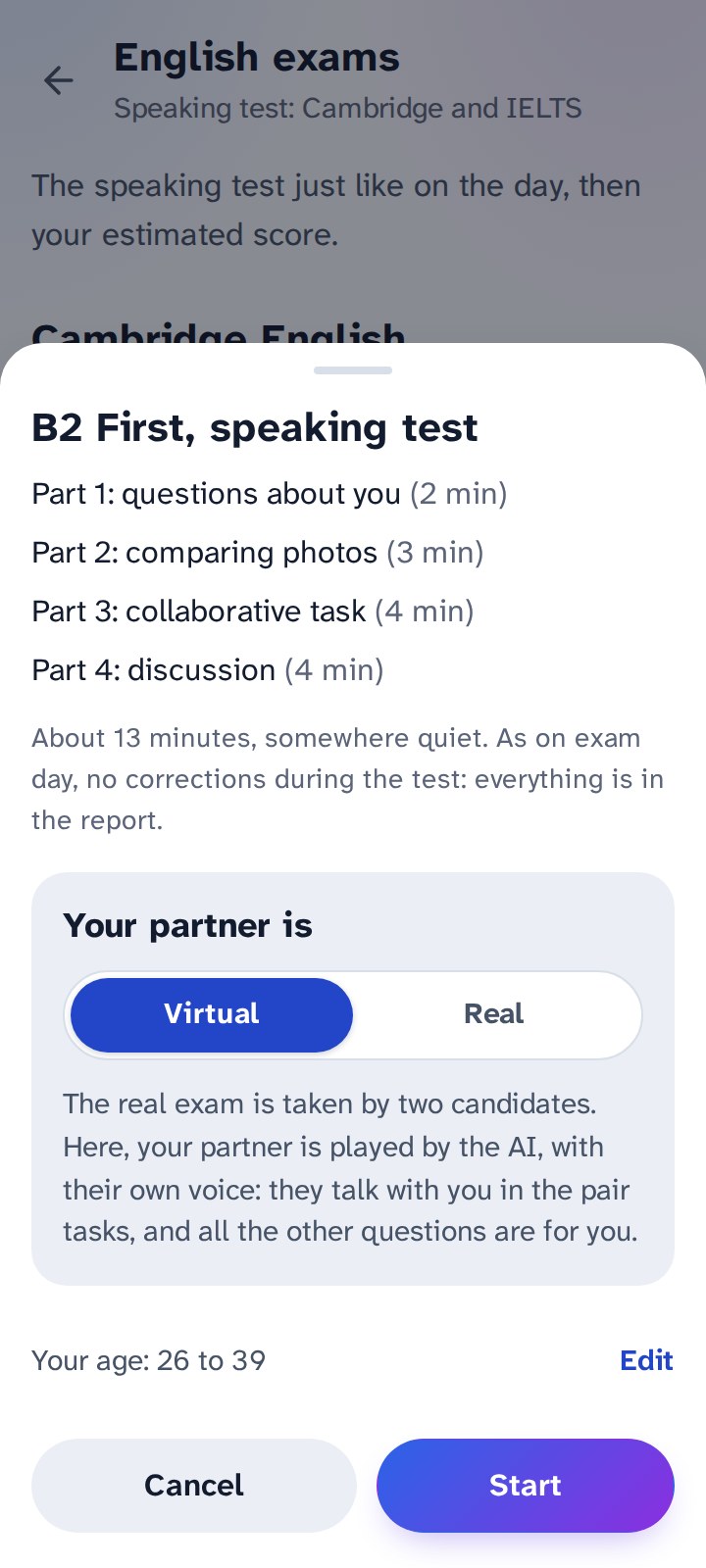
- A virtual partner, with their own voice: on your own, the other candidate is played by the AI. They offer to start (“Shall I start?”), react to your ideas, sometimes question your view like a real candidate, and don't push for a decision before the last minute.
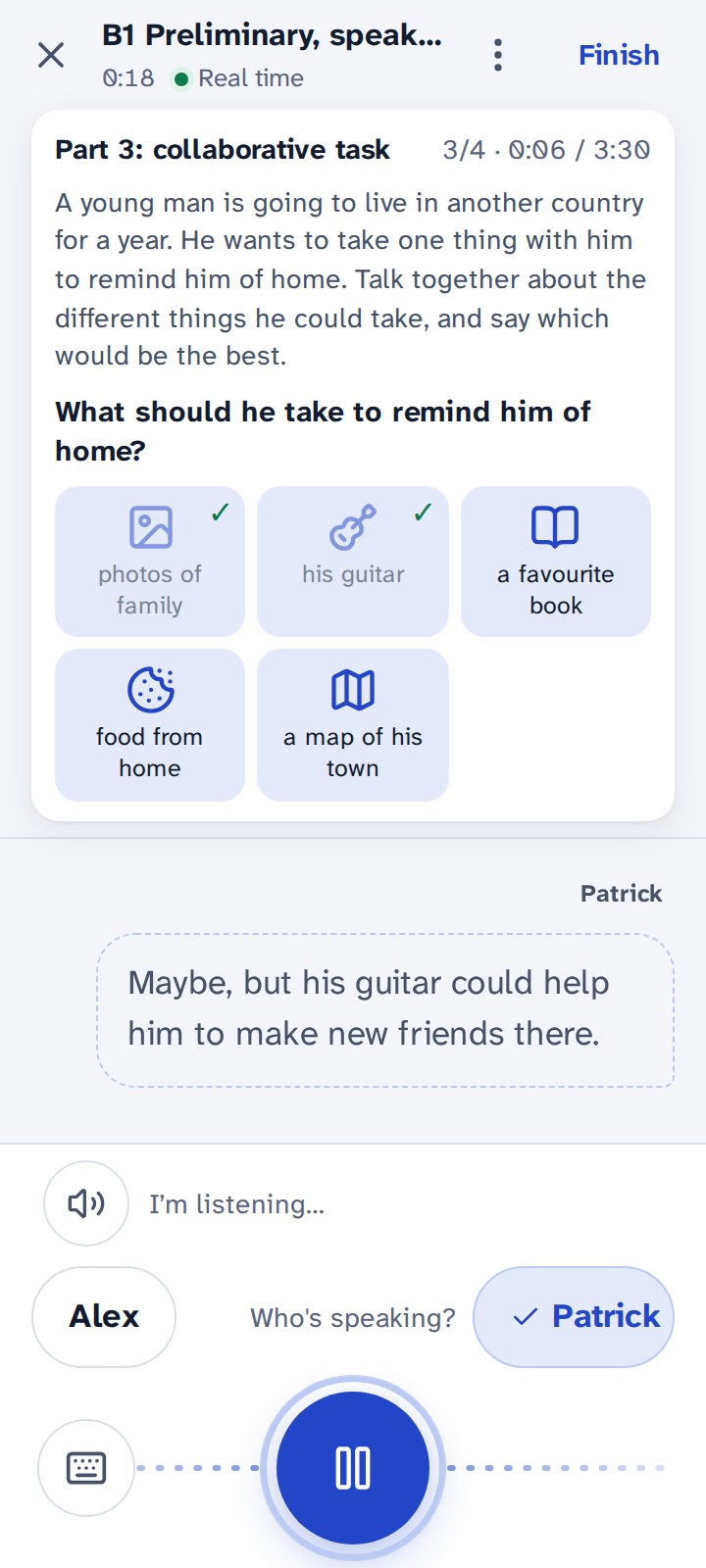
- Or a real person: in pairs on the same phone, each of you taps your name before speaking; the examiner stays silent during your discussion, as in the real exam. Each of you gets your own report.
- The question and the five ideas on screen: each idea you discuss gets a tick, and a countdown shows the time for the discussion, then for the decision.
- The whole test: questions about you, photos, the collaborative task and the final discussion, with an AI examiner, out loud.
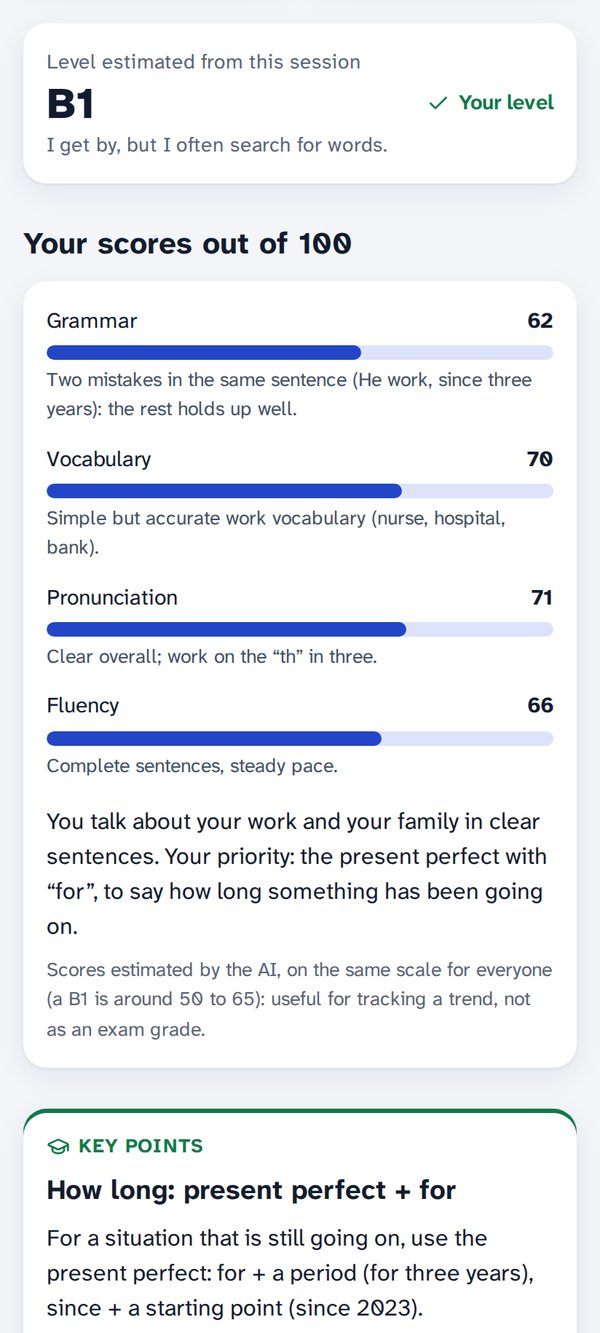
- A report at the end: your estimated score on the Cambridge English Scale (B2 First is reported from 140 to 190), a score for each criterion, including interaction, and your sentences corrected.
Nothing to download: everything works in the browser, on your phone or your computer. The app is for people aged 18 and over.
Frequently asked questions
How long is Part 3 of B2 First Speaking?
About 4 minutes: two minutes discussing the five ideas, then one minute to decide, plus the examiner's instructions.
Do we have to agree?
No. You should try, but a polite, well-argued disagreement is fine. What counts is the quality of the discussion.
Do we have to talk about all five ideas?
No. Three or four ideas discussed well are better than five rushed ones.
How can I practise Part 3 without a partner?
With Goudilingua: a virtual partner, played by the AI with their own voice, discusses with you like a real candidate, while an AI examiner runs the test.
Can we practise in pairs?
Yes, on the same phone: each of you taps your name before speaking, and each of you gets your own report at the end.
Is Goudilingua linked to Cambridge?
No, Goudilingua is not affiliated with Cambridge University Press & Assessment. Tasks are original and the score is an estimate.

Speak English, fear-free. A little better every day.
7-day free trial, no card needed: your email address is all it takes. Ages 18 and up.